
Hair fixative polymers are the chemistry that turns a styling product into a held shape. Choosing the right one determines how a gel, spray, mousse, or cream performs on the four axes formulators benchmark against: hold strength, humidity resistance, flaking, and sensory feel. The selection has gotten harder as microplastic regulation, bio-based launches, and shifting brand positioning reshape the formulation toolkit. This guide covers how fixatives work, how the major polymer families compare, how choice maps to delivery system, and where bio-based alternatives stand today.
Key Takeaways
- Hair fixative polymers deposit as thin films that bond adjacent fibers at their contact points, creating the mechanical structure that holds a set style in place.
- Four axes drive polymer selection: hold strength, humidity resistance, flake and residue behavior, and sensory feel (tack, stiffness, combability).
- Glass transition temperature (Tg) is the central material property. Higher-Tg polymers deliver harder hold but flake more easily; lower-Tg polymers flex better but trend toward tack under humidity.
- Delivery system shapes polymer choice. Aerosols favor high-Tg acrylates, gels favor neutralized acrylate copolymers or VP/VA copolymer, and anhydrous systems favor oil-dispersible polyurethanes.
- Microplastic-free and bio-based fixatives (cellulose derivatives, inulin, maltodextrin, chitosan, corn-derived polymers) are now commercially viable, though humidity resistance and durable hold remain the most common performance gaps versus VP/VA and modified acrylates.
How Hair Fixative Polymers Work
Hair fixative polymers deposit a thin film on the hair surface, dry into a rigid or semi-rigid solid, and bond adjacent fibers at their contact points. The film mechanically constrains fibers into the shape they held at application and resists the forces (humidity, gravity, grooming) that would pull them back. Two properties drive the result: adhesion to the fiber and cohesion across the film itself.
Adhesion and cohesion
Polymer chains must adhere to the keratin cuticle and cohere to themselves across fiber-to-fiber gaps. At the points where fibers cross or run parallel, the polymer film effectively welds adjacent fibers into a composite structure that resists the mechanical and environmental forces acting to pull the style back1.
Where fibers cross, the polymer forms small welds that lock the set. Where fibers run parallel, the polymer creates longer seams that distribute mechanical load. Hair behaves as a polymer-fiber composite, and the performance of that composite depends on both polymer-to-fiber adhesion and polymer-to-polymer cohesion1.
Film formation and glass transition temperature
Film formation follows the path every solvent-borne coating takes: the carrier (typically water or ethanol) evaporates, polymer chains approach each other, and the system coalesces into a continuous film. The glass transition temperature (Tg) of that dried film is the single most useful material property for predicting how it will behave on hair.
Tg controls three performance behaviors formulators design around:
- Below Tg: The film is rigid and strong. This delivers hard hold but promotes flaking under flex or shear.
- Above Tg: The film is rubbery and flexible. This preserves hold under movement but allows tackiness in humid conditions.
- Blending across Tg: Formulators routinely combine polymers with different Tg values to position the effective film behavior in the target zone for a given product format.
For the broader view of film-forming chemistry across skin, hair, color, and sun care, see Vivify’s formulator’s guide to film formers in cosmetics.
The Four Performance Axes Formulators Benchmark
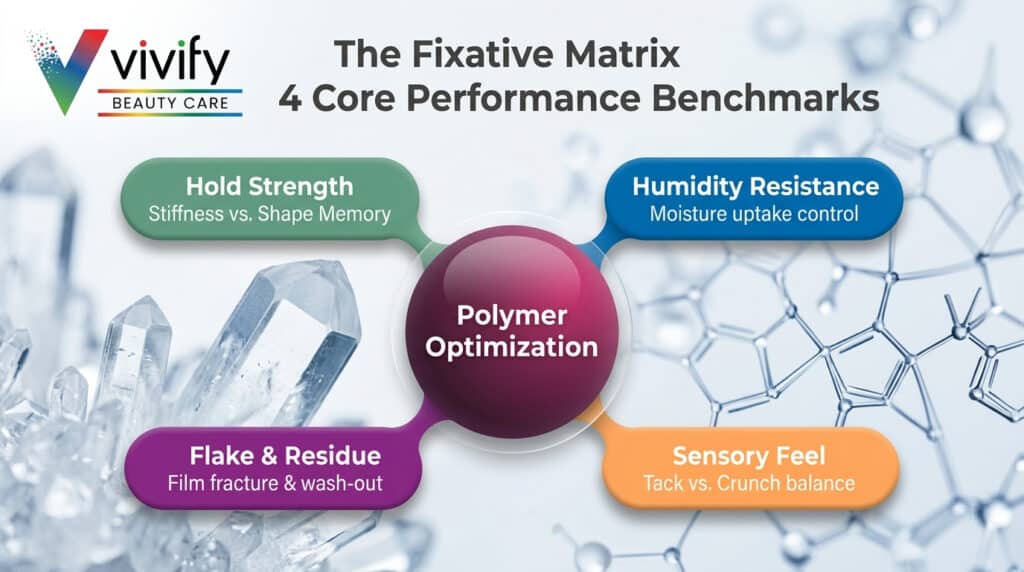
Four performance axes define how a hair fixative polymer will behave in the finished product: hold strength, humidity resistance, flake and residue behavior, and sensory feel. These are the axes formulators measure against during screening and the benchmarks consumer panels eventually confirm or reject.
Hold strength
Hold strength is the force required to deform or restyle treated hair. In the lab it’s typically measured as the mechanical stiffness of a treated tress under bending. High-Tg, strongly adherent polymers (octylacrylamide/acrylates copolymers, high-VP PVP) deliver the hardest hold. Flexible polymers with internal crosslinks (polyurethane-14 / AMP-acrylates copolymer) deliver firm hold with restyle-ability that marketing teams describe as “memory.” The film relaxes under shear, then recovers toward its set shape.
Humidity resistance
Humidity resistance is how well the set survives exposure to atmospheric moisture, and it is the single biggest differentiator between fixative polymers. Hygroscopic polymers like PVP absorb water from the air, plasticize, lose cohesive strength, and let the style relax. Less hygroscopic polymers (VP/VA copolymers with higher VA content, hydrophobically modified acrylates) resist moisture uptake and hold their mechanical properties longer.
The relationship between charge density, cohesion, and humidity is well documented: at high relative humidity, moisture plasticizes the film and electrostatic adhesion to the hair becomes the dominant hold mechanism2. That shift is why charge chemistry matters more as humidity climbs.
Flake and residue
Flake is the mechanical failure mode of an overly rigid film. When film stress exceeds film flexibility, the polymer fractures and produces the visible white particles that drive consumer complaints. Flaking correlates with high Tg, high use level, incomplete film formation, and incompatibility with the rest of the formula.
Residue is the cumulative buildup across repeat applications, especially in non-water-soluble systems. Cleanability through normal shampooing is a standard screening criterion: if a polymer resists wash-out, plan for a shampoo compatibility study.
Sensory feel: tack, stiffness, combability
Sensory feel covers the attributes consumer panels evaluate and product claims push against. The three key measures break down as follows:
- Tack: The sticky, adhesive surface feel. Tracks with low-Tg polymers and elevated ambient humidity.
- Stiffness and crunch: Track with high-Tg, high-use-level films, and are the dominant feel attribute in strong-hold aerosols.
- Combability: Depends on the dried film’s surface lubricity. Tune with silicones, cationic conditioning agents, or plasticizers.
The trade-off is rarely solved by a single polymer. Most commercial formulas blend two or three fixatives to cover the full sensory map.
Polymer Families at a Glance
Hair fixative polymers sort into a small number of functional families defined by backbone chemistry, charge, and typical use system. The table below summarizes the major families formulators encounter and their profile on the four axes above3.
| Family | Charge | Representative INCI | Hold profile | Humidity resistance | Common systems |
| PVP | Non-ionic | Polyvinylpyrrolidone | Stiff, hard | Low | Aqueous lotions, mousses, setting gels |
| VP/VA Copolymer | Non-ionic | VP/VA Copolymer | Medium to firm | Moderate to high (rises with VA ratio) | Aqueous sprays, gels, mousses |
| Acrylates Copolymer | Anionic | Acrylates Copolymer | Medium to firm | Moderate | Gels, creams, pump sprays |
| Octylacrylamide / Acrylates | Amphoteric | Octylacrylamide/Acrylates/Butylaminoethyl Methacrylate Copolymer | Firm to hard | High | Aerosol hairsprays |
| Polyurethane | Anionic / Non-ionic | Polyurethane-14 (+ AMP-Acrylates Copolymer) | Flexible firm, “memory” | High | Anhydrous/solvent sprays, pomades |
| Polyquaternium | Cationic | Polyquaternium-11 | Medium, conditioning | Moderate | Conditioning sprays, mousses |
| Bio-based polysaccharides | Various | Maltodextrin, modified cellulose, chitosan, inulin | Light to firm | Variable | Aqueous sprays, gels (clean-label positioning) |
A closer look at each family explains the trade-offs the table summarizes:
- PVP (polyvinylpyrrolidone): The classic water-soluble fixative: stiff hold, easy wash-out, but poor humidity performance on its own. Vivify’s AccessFIX K60 is a representative PVP for water-based systems.
- VP/VA copolymer: The modern workhorse, pairing vinyl pyrrolidone with vinyl acetate to balance water solubility against hydrophobic behavior. VA ratio is the dial: higher VA means better humidity resistance and softer feel, while higher VP means harder hold and easier wash-out. AccessFIX PNI73 is a VP/VA copolymer formulators can tune across this range.
- Acrylates copolymers and octylacrylamide/acrylates/butylaminoethyl methacrylate copolymer: The aerosol category workhorses, delivering strong hold with improved humidity resistance. Neutralization chemistry matters significantly for anionic acrylates: the choice of neutralizer affects film plasticization and can shift the same polymer between a softer, flexible film and a harder, ionically crosslinked one1.
- Polyurethane-14 / AMP-acrylates copolymer: The category-defining “memory” polymer, delivering firm hold that can be combed through and reformed without full breakdown. Favored in anhydrous solvent sprays and pomades.
- Polyquaternium-11: A cationic film former that combines fixation with conditioning, commonly used in styling sprays and mousses where light hold, antistatic performance, and wet-combing benefits are all needed together. For the broader cationic chemistry view, see Vivify’s post on cationic conditioners for modern haircare.
Fixation and conditioning remain distinct functional outcomes, even when one polymer delivers both. Vivify’s conditioning agents for hair care guide treats the conditioning side in detail.
Matching Polymer Choice to Delivery System
Polymer selection is not only about the four performance axes. The delivery system imposes its own constraints on polymer solubility, viscosity, propellant compatibility, and pack stability. The mapping below reflects how most commercial formulas resolve those constraints.
- Aerosol hairsprays: VOC-constrained, solvent-borne, fast-drying systems. Favor high-Tg acrylate polymers that form hard films rapidly as alcohol and propellant flash off. Octylacrylamide/acrylates/butylaminoethyl methacrylate copolymer is the classical workhorse, with neutralized anionic acrylates and polyurethanes filling specific hold and humidity targets.
- Pump sprays and non-aerosol mists: Run at higher water content and need polymers that dry well without aggressive propellant flash. Water-soluble VP/VA copolymers and neutralized acrylates dominate this space.
- Gels: The fixative polymer must coexist with a thickener network (typically carbomer or an acrylates/C10-30 alkyl acrylate crosspolymer) without compromising viscosity or clarity. PVP, VP/VA copolymer, and acrylates copolymer are all common choices. For the thickener side of the system, see Vivify’s selection guide to rheology modifiers in cosmetics; for the full range of gel-suitable functional ingredients, explore the gels product suitability hub.
- Creams and mousses: Combine fixative film formation with emulsion stability. Non-ionic and cationic polymers (VP/VA copolymer, Polyquaternium-11) are generally easier to stabilize in oil-in-water emulsions than anionic acrylates, which can destabilize charge-sensitive emulsifier systems.
- Anhydrous waxes and pomades: Water is off the table. Oil-dispersible polymers and polyurethane systems dominate; water-soluble PVP is not a viable sole fixative in these formats.
The Bio-Based and Microplastic-Free Shift
The move toward bio-based and microplastic-free fixatives is driven by three forces: new regulation, brand clean-label commitments, and consumer preference for naturally derived ingredients. The regulatory lead is Commission Regulation (EU) 2023/2055, which restricts intentionally added synthetic polymer microparticles under REACH Annex XVII. The rule sets transitional deadlines of October 17, 2029 for leave-on cosmetics (including hair styling gels and creams) and October 17, 2027 for rinse-off products. The commercial result is a growing portfolio of bio-based styling polymers that formulators can now evaluate against conventional synthetics3. The global hair styling market sits near USD 9.96 billion, with the Europe segment at roughly USD 7.28 billion. Both segments are absorbing this reformulation wave rather than slowing it.
Commercial bio-based options available today include:
- Maltodextrin: A sugar-derived polymer that forms clear, hard films in water-based gels and lotions. Performs best in low-humidity environments; hygroscopic behavior parallels PVP.
- Modified cellulose derivatives and upcycled cellulose gums: Deliver balanced hold and flexibility in water-based systems. Several recent launches have positioned the cellulose route as the clean-beauty analog to VP/VA.
- Inulin and agave inulin blends: Chicory- and agave-derived soluble polysaccharides now appearing in microplastic-free hairsprays and gels, per a 2023 Cosmetics Business report on microplastic-free hair styling polymers.
- Chitosan and chitosan derivatives: Cationic, film-forming, and substantive to damaged hair. Supply chain is narrower and ingredient cost is higher than for synthetic alternatives, which affects scale planning.
- Corn-derived polymers: Modified corn starch derivatives are positioned as a clean-beauty counterpart to PVP for formulators who want a water-soluble, clear-film fixative, though performance typically trails PVP on stiffness and humidity resistance.
The performance picture is honest, not absolute. Bio-based fixatives have closed significant ground on hold and flexibility, but humidity resistance and durable wear under real-world conditions remain the most common gaps relative to high-VA VP/VA copolymers and hydrophobically modified acrylates. Formulators moving to bio-based should plan for polymer blending, reformulated claim language, and a broader stability program. For options Vivify curates specifically for this positioning, see the clean and natural ingredients portfolio, which reflects Responsible Mica Initiative-aligned sourcing and cruelty-free, vegan options across the range.
Testing and Claim Support for Hair Fixative Polymers
Objective polymer testing translates lab data into defensible consumer claims. Three methods carry the most weight in screening and claim support.
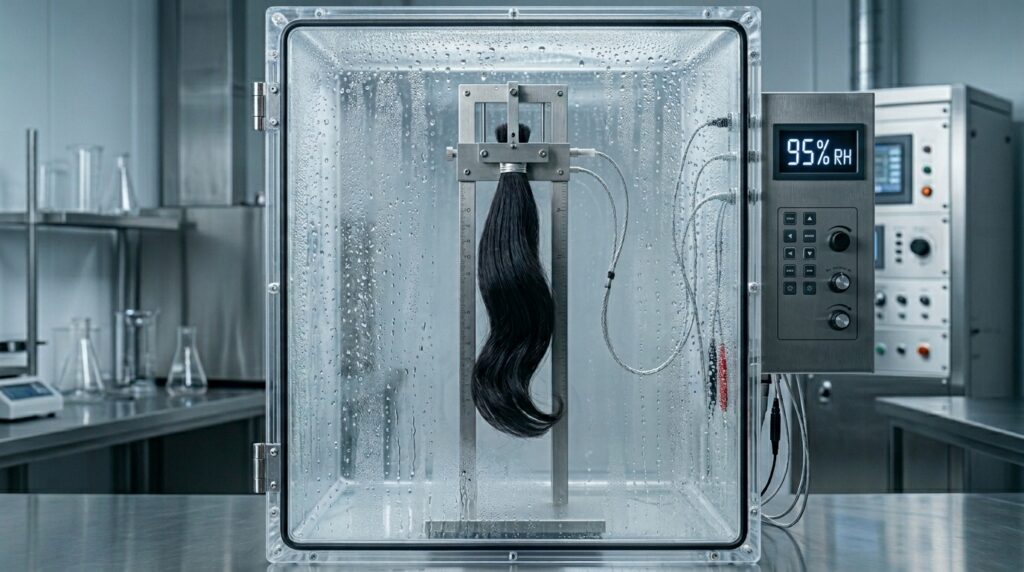
- High-humidity curl retention: Treated tresses are curled, dried, measured, then exposed to roughly 90% relative humidity at 20–25°C for 24 hours, and curl geometry is re-measured. The percentage of retained curl is the primary metric and the most cited humidity-resistance benchmark in the fixative literature. No formal ASTM or IFSCC standard codifies the protocol; individual labs run internal variants of the same basic method4.
- Mechanical stiffness testing: Three-point bending, cantilever bending, or omega-loop bending quantifies hold strength as the force required to deflect a treated tress. These methods distinguish mild, medium, strong, and super-hold polymer systems in a measurable way and support tiered hold claims4.
- Sensory panels and instrumented sensory analysis: Trained panels evaluate tack, stiffness, crunch, and combability against a reference; instrumented friction and surface-energy tests supplement. Sensory data is required for any “natural feel,” “touchable hold,” or “no-crunch” claim, and it complements the mechanical data that supports hold claims.
For the parallel framing on how water-resistance and durability claims are built and substantiated more broadly, see Vivify’s piece on water resistance claims in cosmetics.
Frequently Asked Questions About Hair Fixative Polymers
What is the difference between anionic, cationic, and non-ionic hair fixatives?
Anionic fixatives (acrylates copolymers, carboxylated polyurethanes) carry negative charges that are neutralized during formulation; they deliver strong hold but can interact with cationic conditioning ingredients. Cationic fixatives (Polyquaternium-11, chitosan derivatives) carry positive charges that drive substantivity on damaged hair but can interact with anionic surfactants. Non-ionic fixatives (PVP, VP/VA copolymer) carry no net charge and are the easiest to combine across formulation systems.
How do you test humidity resistance in hair styling polymers?
The standard benchmark is curl retention under controlled humidity. Treated tresses are curled, dried, and measured, then held in a chamber at roughly 90% relative humidity at 20–25°C for 24 hours, after which curl geometry is re-measured. Percentage of retained curl is the primary metric. Supplementary methods include gravimetric moisture uptake on the free polymer film and dynamic mechanical analysis (DMA) under varied humidity to characterize how the film softens as water is absorbed.
Are hair fixative polymers damaging to hair long-term?
No direct causal link between commercial hair fixative polymers and cuticle or cortex damage has been established under normal use conditions. Fixative polymers deposit on the hair surface and are removed through shampooing; they do not penetrate the cortex or react with keratin the way oxidative colorants or repeated high-heat styling do. Concerns about “buildup” reflect incomplete polymer removal rather than structural damage.
What are the natural alternatives to synthetic styling polymers?
Commercial bio-based fixatives include maltodextrin, modified cellulose derivatives, chitosan and chitosan derivatives, inulin blends, and corn-derived polymers. These support clean-label and microplastic-free positioning but vary in how closely they match VP/VA copolymer and hydrophobically modified acrylates on humidity resistance and durable hold. Polymer blending is often needed to close specific performance gaps rather than substituting one-for-one.
Work With Vivify on Your Next Styling Launch
Selecting a hair fixative polymer is a balancing act across hold, humidity, feel, and delivery system. Vivify’s hair fixative polymers portfolio spans PVP, VP/VA copolymer, acrylates, polyurethanes, and Polyquaternium-11 options for both aqueous and anhydrous systems, alongside bio-based alternatives for clean-label positioning. To evaluate options for a specific launch or run a sample trial, connect with a Vivify formulation specialist.
References
1. Rafferty, D. W., Zellia, J., Hasman, D., & Mullay, J. (2008). Polymer composite principles applied to hair styling gels. Journal of Cosmetic Science, 59(6), 497–508. https://pubmed.ncbi.nlm.nih.gov/19156332/
2. Rafferty, D. W., Zellia, J., Hasman, D., & Mullay, J. (2009). The mechanics of fixatives as explained by polymer composite principles. Journal of Cosmetic Science, 60(2), 251–259. https://pubmed.ncbi.nlm.nih.gov/19450424/
3. Alves, T. F. R., Morsink, M., Batain, F., Chaud, M. V., Almeida, T., Fernandes, D. A., da Silva, C. F., Souto, E. B., & Severino, P. (2020). Applications of natural, semi-synthetic, and synthetic polymers in cosmetic formulations. Cosmetics, 7(4), 75. https://doi.org/10.3390/cosmetics7040075
4. McMullen, R. L., & Gillece, T. (2023). Development of a three-point cantilever bending technique to study the mechanical properties of hair styling ingredients. Skin Research and Technology, 29(1), e13256. https://doi.org/10.1111/srt.13256