
Choosing a cosmetic preservative system is one of the highest-stakes decisions a formulator makes. The wrong choice surfaces as microbial growth, recalls, or failed challenge tests months after launch, when the cost of changing course is highest. This guide walks through the formulation variables that actually drive selection, how hurdle technology coordinates them, what the ISO 11930 challenge test asks for, and where U.S. and EU rules diverge.
Key Takeaways
- Preservation failure is the leading cause of cosmetic recalls. Microbial contamination accounted for 76.8% of all U.S. cosmetic dermatology product recalls between 2011 and 2023, including 80% of the most serious (Class I) recalls.1
- Preservative selection is driven by five formulation variables: pH, water activity, emulsion type, packaging, and intended market. Pick the system based on the product, not the other way around.
- Hurdle technology coordinates multiple stress factors. Combining controlled pH (typically 4 to 9), reduced water activity, GMP, protective packaging, and antimicrobial ingredients can reduce or eliminate reliance on synthetic preservatives.2
- ISO 11930 is the global benchmark for preservation efficacy testing. The challenge test inoculates the formula with five reference organisms and measures log reductions at 0 hours, 7 days, 14 days, and 28 days against Criterion A or Criterion B.
- EU and U.S. systems are structurally different. Annex V of EU Regulation 1223/2009 is a positive list of allowed preservatives with concentration caps. The U.S. Modernization of Cosmetics Regulation Act (MoCRA) does not pre-approve preservatives but requires facility registration, product listing, safety substantiation, and adverse event reporting.
- Multifunctional ingredients are the modern preservation lever. Peer-reviewed work has demonstrated synergistic combinations of multifunctional ingredients (such as sodium coco PG-dimonium chloride phosphate paired with ricinoleic acid and sorbitan caprylate) that deliver self-preserving systems passing standard challenge protocols.3
Why Preservative System Selection Drives Product Safety and Compliance
Preservation failures cause more cosmetic recalls than any other category of product defect. A 2025 cross-sectional analysis published in the Journal of the American Academy of Dermatology identified 334 cosmetic dermatology product recalls between 2011 and 2023, encompassing more than 77 million units.1 Microbial contamination drove 76.8% of those recalls, including 80% of Class I recalls (the category reserved for products that may cause serious adverse health consequences).1
The contamination profile is consistent and worth memorizing. Bacteria accounted for 80% of contaminating pathogens, dominated by Pseudomonas species (54.9%) and Burkholderia species (24.8%).1 Median recall duration was 307 days, with an interquartile range of 185 to 461 days.1 That timeline matters: a preservation failure is rarely contained quickly, and the financial and brand exposure compounds across the recall window.
Industry sources confirm that consumer perception adds pressure on top of microbiological reality. As one supplier executive noted in Happi, “the perception of preservatives in the general public is still somewhat negative,” which has driven a sustained pull toward preservative-free positioning even when the underlying microbial risk has not changed. The job of the formulation team is to translate that pressure into a defensible system, not to remove preservation from the formula.
How to Choose a Preservative System: Five Variables That Drive Selection
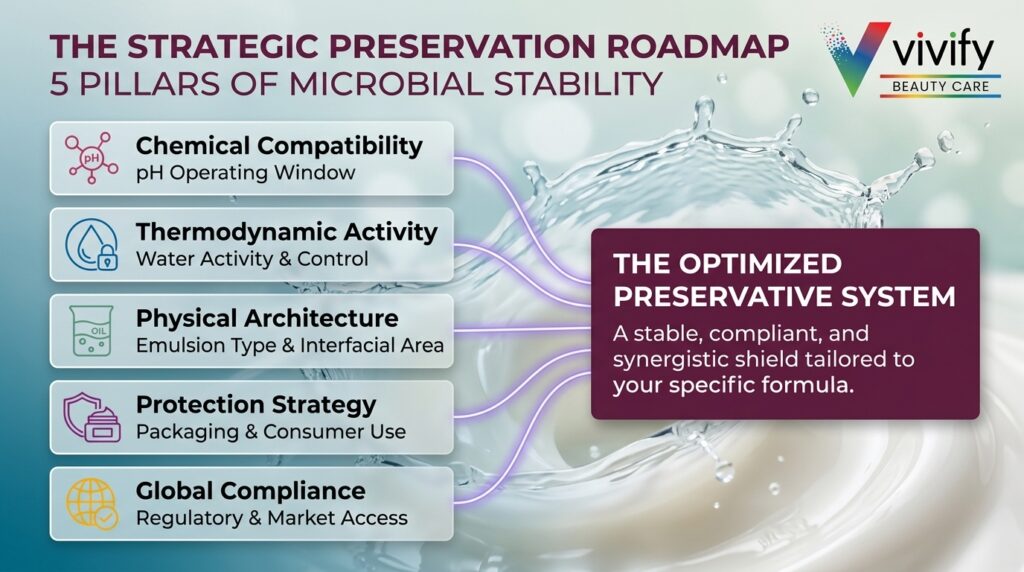
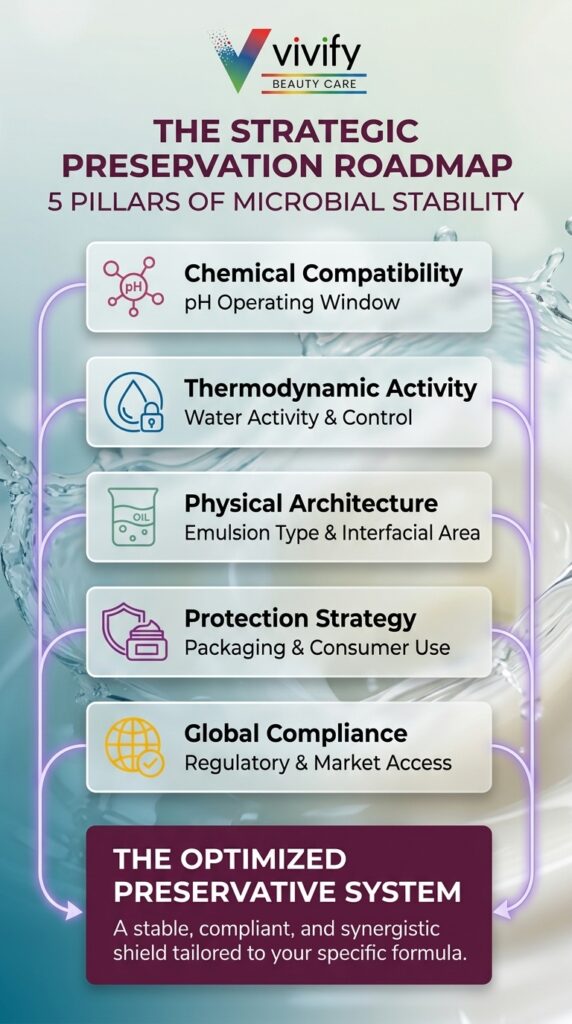
Preservative selection should follow the formula, not precede it. Five variables determine which chemistry works and which fails: pH, water activity, emulsion type, packaging, and intended market. Run through each before locking the preservative system in.
pH of the finished formula
Most cosmetic preservatives have a narrow window of maximum efficacy. Organic acid systems (sorbic, benzoic, levulinic, anisic) require low pH (typically below 5.0 to 5.5) to remain in their active, undissociated form, while phenoxyethanol is broadly active across pH 4 to 8. Formaldehyde donors are functional across a wide range but often paired with organic acids for Gram-negative coverage. Confirm the pH operating window of every candidate against the finished formula’s target pH before screening anything.
Water activity of the formula
Water activity (aw) is the single most under-used lever in cosmetic preservation. Microbial growth requires free water; bound water is unavailable. Reducing aw through humectants, salts, polyols, protein hydrolysates, amino acids, or hydrocolloids increases the formula’s intrinsic resistance to spoilage and reduces the load on the antimicrobial ingredients in the system.2
Anhydrous and very-low-water products (oil cleansers, balms, lipsticks, color powders) often need only oxidative protection rather than a full preservative system. Oil-in-water emulsions, gels, serums, and toners have higher water activity and require broad-spectrum coverage. Match the system’s spectrum to the formula’s water activity before debating ingredient class.
Emulsion type and oil phase
Oil-in-water (O/W) emulsions present the most demanding preservation challenge: a continuous water phase, dispersed oil droplets that can partition the preservative away from where microbes grow, and significant interfacial area for surfactant-driven inactivation. Water-in-oil (W/O) systems are easier to preserve because the oil phase limits microbial access to water, while anhydrous systems generally do not require traditional preservation. Surfactant choice in cleansing formulas also affects preservation, since nonionic surfactants can sequester certain preservatives and reduce their free concentration. For a deeper read on how surfactant class interacts with the rest of the system, see the cosmetic surfactants formulation guide.
Packaging and product use pattern
Packaging is part of the preservation system. Airless pump systems, tubes, and unit-dose formats reduce contamination ingress and lower the burden on the chemical preservative. Open jars introduce repeated finger contact and air exposure, raising the bar on the preservative system. Build the packaging decision into the preservation brief at the same time as the chemistry decision.
Intended market and regulatory framework
EU markets require ingredients on the Annex V positive list at or below the listed maximum concentration. U.S. markets operate under MoCRA, which sets a different compliance burden (registration, listing, safety substantiation, adverse event reporting) without a pre-approved preservative list. Asian, Latin American, and Middle Eastern markets layer additional country-specific rules. A preservative that works technically in the lab is irrelevant if it cannot ship in the target market, so lock the regulatory question early.
Hurdle Technology: Coordinating Preservation Levers
Hurdle technology is a coordinated approach in which multiple preservation factors operate at sub-maximum levels but together create an environment hostile to microbial growth. The concept moved into cosmetics from food science, and it is now the dominant framework for self-preserving and reduced-preservative systems. A 2024 peer-reviewed review of hurdle technology in cosmetics describes the typical levers as strict manufacturing practices, optimal packaging, pH adjustments (generally between 4 and 9), reduced water activity, and antimicrobial ingredients used in combination.2
Hurdle technology works because no single hurdle has to do all the work. A formula at pH 4.5 with low water activity, in airless packaging, with a multifunctional ingredient blend providing residual antimicrobial activity, can pass challenge testing on a fraction of the preservative load that a pH 6.5 jar product would require. The trade-offs to manage:
- pH adjustments: organic acids and many actives demand low pH; some emulsifiers, peptides, and rheology modifiers prefer neutral. Reconcile competing pH requirements before locking the preservation strategy.
- Water activity reduction: high humectant or polyol loading can affect texture, sensory profile, and stability; balance preservation gains against consumer experience targets.
- Packaging selection: airless packaging adds cost and constrains brand identity for some product categories; weigh against the preservation load it removes.
- Manufacturing controls: hurdle systems are less forgiving of GMP lapses than systems built around traditional broad-spectrum preservatives. Process discipline becomes part of the safety margin, not a backstop.
Multifunctional Ingredients as Preservative Boosters and Self-Preserving Systems
Multifunctional ingredients (MFIs) deliver antimicrobial activity alongside another claimed function (humectancy, emolliency, conditioning, sensory). They sit on INCI lists as actives or functional ingredients, not as preservatives, which gives marketing teams the “preservative-free” or “clean” framing they often want, while still providing real microbial protection. Used on their own, most MFIs are not sufficient. Used in coordinated combinations and inside a hurdle technology framework, they can carry a complete preservation load.
A 2024 study in Scientific Reports tested 150 combinations of five candidate MFIs (sodium coco PG-dimonium chloride phosphate, ricinoleic acid, palmitoleic acid, raspberry ketone, and sorbitan caprylate) and identified synergistic combinations capable of producing self-preserving personal care formulations that passed the PCPC/ISO 11930 efficacy criteria.3 The headline finding for formulators is not the specific molecules but the principle: MFIs must be screened in combination, not individually, because synergy (or antagonism) is the dominant performance signal. Compatibility with sensitive actives also matters at this stage. The guide to mastering peptides in skincare formulation walks through the chelator and pH constraints that come with peptide actives and that flow directly into preservative selection.
Common multifunctional categories worth screening:
- Diols and polyols: 1,2-pentanediol, 1,2-hexanediol, caprylyl glycol, propanediol, glycerin at high loading. Reduce water activity and contribute mild antimicrobial activity.
- Fatty acid derivatives: sorbitan caprylate, glyceryl caprylate, ethylhexylglycerin. Active against Gram-positive organisms and yeast; often paired with phenoxyethanol or organic acids for full spectrum.
- Aromatic alcohols and acids: benzyl alcohol, anisic acid, levulinic acid, sodium levulinate. Acid forms require low pH; salt forms broaden pH compatibility but reduce undissociated active fraction.
- Chelators: disodium EDTA and tetrasodium glutamate diacetate sequester divalent cations that biofilms and Gram-negative organisms rely on, multiplying the apparent activity of the primary preservative system. Chelators are not preservatives on their own; their value is as boosters within the broader hurdle framework.
ISO 11930 Preservative Efficacy Testing: The Challenge Test Workflow
Preservation efficacy testing (PET) is the laboratory verification step that confirms whether the chosen system actually controls microbial growth in the finished formula. ISO 11930:2019 (with Amendment A1:2022) is the global reference standard. The protocol inoculates the formula with a defined panel of challenge organisms, samples at fixed intervals, and measures log reductions against pass/fail criteria.
The five challenge organisms
ISO 11930 specifies five reference organisms covering the spectrum of cosmetic contamination risk:
- Pseudomonas aeruginosa, a Gram-negative environmental pathogen and the most common cause of cosmetic recalls.
- Staphylococcus aureus, a Gram-positive skin commensal and opportunistic pathogen.
- Escherichia coli, a Gram-negative indicator of fecal contamination in raw materials or process water.
- Candida albicans, a yeast representing eukaryotic challenge.
- Aspergillus brasiliensis, a mold representing fungal challenge across long-shelf-life products.
Sampling intervals and acceptance criteria
Samples are taken at four time points after inoculation: 0 hours (baseline), 7 days, 14 days, and 28 days. The standard defines two acceptance criteria:
- Criterion A: the formula provides full antimicrobial protection on its own. Required log reductions are met at every sampling point without reliance on packaging or other extrinsic factors.
- Criterion B: the formula achieves modified protection that does not meet Criterion A but provides sufficient protection when combined with a microbiological risk assessment under ISO 29621. Criterion B passing requires documented risk assessment evidence; it is not a fallback for products that fail Criterion A without justification.
Practical PET workflow
A typical PET protocol for a new formula runs through four stages:
- Pre-screen: evaluate the candidate preservation system against compatibility (pH, ionic charge, oil partitioning, surfactant interactions) before booking the challenge test. Failed PETs are usually formulation problems caught too late, not preservative problems.
- Inoculate and sample: at 0 hours, 7 days, 14 days, and 28 days, per ISO 11930. Use the actual finished formula and packaging configuration that will ship, not a representative sample.
- Evaluate against Criterion A or B: Criterion A is the cleaner regulatory path. Criterion B requires defending the gap with an ISO 29621 microbiological risk assessment.
- Re-test on stability protocol: PET should be repeated on aged samples (typically 3-month and stability-end-point) to confirm preservation efficacy across shelf life, not only at time zero.
Cosmetic Preservative Regulation: EU Annex V vs. U.S. MoCRA
The EU and U.S. regulatory systems for cosmetic preservatives are structurally different. The EU operates a positive list under Regulation (EC) No 1223/2009, Annex V, which permits only listed preservatives at or below specified maximum concentrations and under defined conditions of use. The most recent in-force amendment to Annex V is Regulation (EU) 2024/996 (Official Journal, 4 April 2024), and a further amendment proposed under EU notification G/TBT/N/EU/1140 targets a May 2026 application date. Confirm the in-force status with regulatory counsel before publishing claims.
The U.S. system was reshaped by the Modernization of Cosmetics Regulation Act of 2022 (MoCRA), which the FDA describes as the most significant expansion of its cosmetic authority since the Federal Food, Drug, and Cosmetic Act of 1938. MoCRA does not pre-approve preservatives. Instead, it requires facility registration, product listing, safety substantiation, and adverse event reporting. As of January 6, 2026, the FDA reported 14,299 active facility registrations and 992,907 active product listings under the new framework.
EU and U.S. preservative regulation: a side-by-side comparison
| Dimension | EU (Regulation 1223/2009) | U.S. (MoCRA, 2022) |
| Approach | Positive list (Annex V); only listed preservatives permitted. | No pre-approved list; safety substantiation required by manufacturer. |
| Concentration limits | Maximum concentrations specified in Annex V; cannot be exceeded. | No fixed caps; manufacturer must demonstrate safety at use level. |
| Facility registration | Required under EU framework via Cosmetic Product Notification Portal (CPNP). | Required; renew every two years. |
| Product listing | Required (CPNP notification before market). | Required; updates filed annually. |
| Safety substantiation | Cosmetic Product Safety Report (Annex I). | Adequate safety substantiation required; specifics defined in implementing regulation. |
| Adverse event reporting | Serious undesirable effects reported to competent authorities. | Serious adverse events reported to FDA within 15 business days. |
| Independent safety review | Scientific Committee on Consumer Safety (SCCS) opinions inform Annex V. | Cosmetic Ingredient Review (CIR) publishes industry-funded safety assessments. |
Two practical implications for formulators selling into both markets. The EU positive list is the binding ceiling, so building an EU-then-U.S. formulation is more reliable than the reverse. MoCRA’s safety substantiation requirement does not give U.S. teams a free pass; it shifts documentation burden onto the brand and its suppliers.
Frequently Asked Questions About Cosmetic Preservative System Selection
What is the most effective preservative for cosmetics?
There is no single most effective preservative. Effectiveness depends on the formula’s pH, water activity, emulsion type, packaging, and target organisms. Phenoxyethanol paired with a multifunctional booster covers the broadest range of typical leave-on formulas, and organic acid systems work well at pH below 5. The right answer is the system that passes ISO 11930 challenge testing in the actual finished formula and packaging, not a preservative chosen by reputation.
How do you choose a preservative system for cosmetics?
Define the formulation envelope first: pH, water activity, emulsion type, packaging, and target market. Match candidate preservatives or multifunctional-ingredient combinations to that envelope, screen for compatibility with surfactants and actives, then verify with ISO 11930 PET on the production-representative formula. The decision is driven by the formula and the regulatory target, not by ingredient preference.
Are natural preservatives safe and effective for cosmetics?
Naturally derived antimicrobial ingredients can be safe and effective when used inside a coordinated hurdle technology framework, but most are not sufficient as the sole preservation lever. Plant-derived options (such as fermented radish root, leuconostoc/radish root ferment filtrate, and certain essential oil components) typically need to be combined with pH control, water activity reduction, protective packaging, and chelators to pass standard challenge testing. The guide to cosmetic certifications including COSMOS covers which preservatives are permitted under the major natural and organic standards.
What is hurdle technology in cosmetic preservation?
Hurdle technology is a coordinated approach in which multiple preservation factors (pH, water activity, packaging, GMP, and antimicrobial ingredients) operate together at sub-maximum levels to create an environment hostile to microbial growth.2 The framework migrated from food science to cosmetics and is now the dominant strategy for self-preserving and clean-label systems. No single hurdle has to do all the work; the combination is what carries the load.
What does ISO 11930 actually test, and how is it different from older PET methods?
ISO 11930 is a global preservation efficacy test that inoculates the finished formula with five reference organisms (Pseudomonas aeruginosa, Staphylococcus aureus, Escherichia coli, Candida albicans, and Aspergillus brasiliensis) and measures log reductions at 0 hours, 7 days, 14 days, and 28 days against Criterion A or Criterion B. It replaced ISO 11930:2012 in 2019 and was amended in 2022. It harmonizes the previously fragmented USP 51, EP 5.1.3, and JP 19 protocols, although those national pharmacopeial methods remain referenced for specific applications.
Talk to a Vivify Formulation Specialist
Preservation is one of the most consequential parts of a cosmetic formulation, and the right system depends on the specifics of your product, packaging, and market. Vivify Beauty Care offers a preservatives and antimicrobials portfolio alongside preservation and product stability ingredients curated for pH compatibility, regulatory status, and clean-label positioning. Our formulation and lab support team works alongside R&D groups on system selection, compatibility screening, and ISO 11930 strategy. Talk to a Vivify expert to scope a preservation strategy for your next launch.
References
1. Venkatesh, K. P., Kadakia, K. T., Akbarpour, A., & Nambudiri, V. E. (2025). US Food and Drug Administration recalls of cosmetic and personal products from 2011 to 2023: A cross-sectional study. Journal of the American Academy of Dermatology, 92(1), 179–181. https://doi.org/10.1016/j.jaad.2024.09.040
2. Senthilkumar, K., & Vijayalakshmi, A. (2024). Advances in self-preservation techniques in cosmetics using hurdle technology. South Eastern European Journal of Public Health, XXV. https://seejph.com/index.php/seejph/article/view/2278
3. Senthilkumar, K., Vijayalakshmi, A., et al. (2024). Preparation of self-preserving personal care cosmetic products using multifunctional ingredients and other cosmetic ingredients. Scientific Reports, 14, 19401. https://doi.org/10.1038/s41598-024-57782-9