
Cosmetic certifications are among the most powerful trust-building tools available to beauty brands, yet the standards behind labels like “vegan,” “natural,” and “organic” vary dramatically in scope and rigor. For formulators and brand teams, understanding what each certification actually guarantees is essential to building defensible claims and avoiding costly regulatory missteps.
Key Takeaways
The following points summarize the most critical insights from this guide:
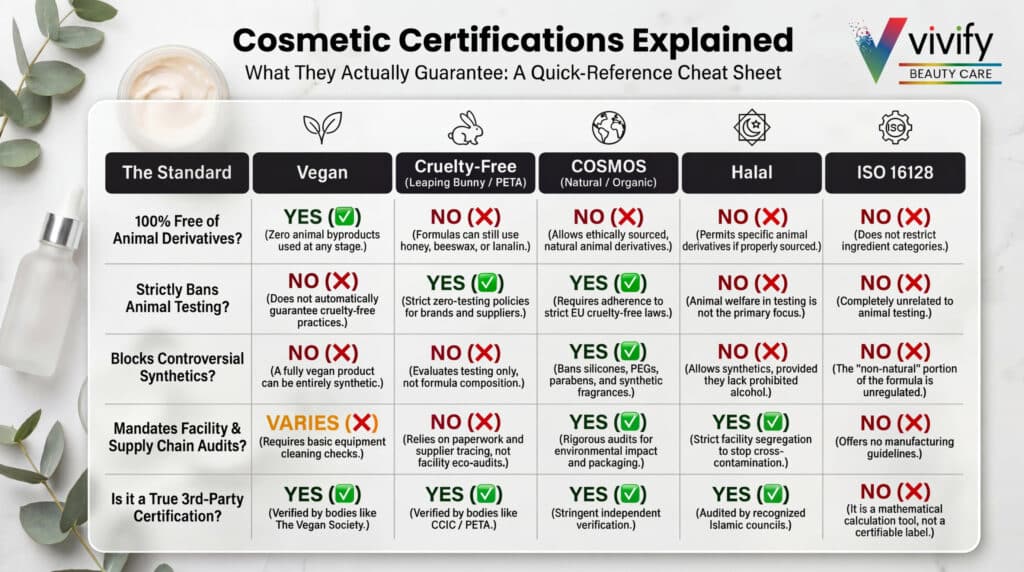
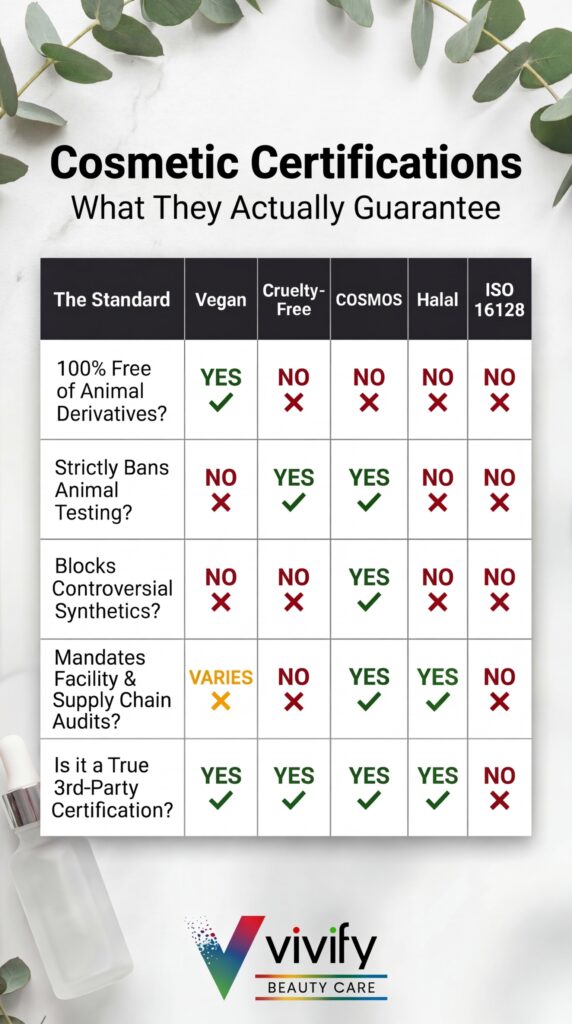
- Vegan and cruelty-free are separate certifications. A product can be vegan (free of animal-derived ingredients) without being cruelty-free, and vice versa. Always verify each claim independently.
- COSMOS certification operates at two levels. COSMOS Natural requires 95%+ natural-origin ingredients; COSMOS Organic requires at least 20% organic content (10% for rinse-off), with manufacturing and packaging audited against strict sustainability criteria.
- Halal cosmetics certification addresses the full supply chain. It covers ingredient sourcing, facility segregation, alcohol restrictions, and cross-contamination controls, not just ingredient composition.
- ISO 16128 provides calculation methods, not certification. It defines naturalness indexes but does not restrict ingredient use, enforce labeling rules, or issue consumer-facing certifications.
- Third-party verification is the minimum standard for defensible claims. Self-declared labels without independent auditing expose brands to greenwashing allegations and increasingly, regulatory penalties.
What Does Vegan Cosmetic Certification Actually Cover?
Vegan certification confirms that a finished product contains no animal-derived ingredients at any stage of production. This includes commonly used materials such as beeswax, lanolin, carmine (CI 75470), collagen, keratin, and squalane derived from shark liver oil. The global vegan cosmetics market was valued at approximately USD 18–19 billion in 2024, with projections showing continued growth above 6% CAGR through 2034.1
Several organizations issue vegan certifications, and their standards differ in meaningful ways:
- The Vegan Society (UK): One of the most widely recognized standards. Products must contain no animal-derived ingredients, and the brand must confirm that neither the product nor its ingredients were tested on animals. The Vegan Society trademark also requires that manufacturing equipment is cleaned between vegan and non-vegan production runs.
- PETA Beauty Without Bunnies: Combines vegan and cruelty-free verification. Companies sign a statement of assurance confirming no animal testing is conducted by the company or its suppliers.
- Leaping Bunny: Primarily a cruelty-free certification from the Coalition for Consumer Information on Cosmetics (CCIC). It does not certify vegan status. Products can carry the Leaping Bunny seal and still contain animal-derived ingredients like honey or milk.
The critical distinction for formulators: vegan does not mean cruelty-free, and cruelty-free does not mean vegan. These are independent claims that require independent verification. When sourcing ingredients for vegan formulations, confirm the vegan status of every raw material, including processing aids and carriers that may not appear on the final INCI list. Vivify’s portfolio of actives and functional ingredients include those with vegan certification to simplify this sourcing process.
COSMOS Certification: Natural and Organic Standards for Cosmetics
COSMOS (COSMetic Organic and Natural Standard) is an internationally recognized framework managed by a nonprofit association in Brussels. It was created by five European certification bodies: ECOCERT (France), BDIH (Germany), Cosmebio (France), ICEA (Italy), and the Soil Association (UK), as documented in the current COSMOS standard (Version 4). The standard harmonizes natural and organic cosmetic definitions across markets and is now used in more than 70 countries.
COSMOS operates at four distinct levels, and the differences matter for both formulation and marketing:
- COSMOS Organic: At least 95% of plant-based ingredients must be organic. A minimum of 20% of the total formula must be organic (10% for rinse-off products). Note that water and minerals cannot count as organic, which limits the achievable organic percentage in aqueous formulations.
- COSMOS Natural: A minimum of 95% of all ingredients must be of natural origin. No minimum organic threshold is required. This tier suits formulations with high water or mineral content where organic percentages are structurally low.
- COSMOS Certified (ingredients): Applies to raw materials and ingredients that meet COSMOS processing and composition criteria. Ingredient suppliers can certify individual raw materials to simplify downstream product certification.
- COSMOS Approved (ingredients): Covers raw materials that are approved for use within COSMOS-certified formulations but do not themselves carry full certification.
Beyond ingredient composition, COSMOS audits manufacturing processes, packaging, and environmental management practices. Prohibited categories include parabens, phenoxyethanol, synthetic fragrances and colorants, silicones, PEGs, and ingredients derived from petrochemical sources. For formulators, this means COSMOS certification constrains not just what goes into a formula but how it is manufactured. Production facilities must demonstrate environmentally responsible practices, and packaging must be biodegradable or recyclable.
If your formulations require COSMOS-approved raw materials, verifying certification status at the ingredient level prevents delays during product certification. Vivify’s catalog includes functional ingredients filterable by certification status, including Ecocert-approved emulsifiers and conditioning agents.
Halal Cosmetics Certification: Beyond Ingredient Exclusions
Halal certification for cosmetics confirms that products are manufactured in accordance with Islamic law (Shariah). While ingredient composition is the starting point, halal certification reaches significantly deeper into the supply chain and manufacturing process than most brands expect.2
Halal cosmetics must meet several interconnected requirements:
- Prohibited ingredients: Products cannot contain ingredients derived from pork, blood, carrion, human body parts, predatory animals, reptiles, or insects. Carmine (CI 75470), derived from cochineal insects, is one of the most commonly flagged ingredients in color cosmetics.
- Alcohol restrictions: Ethanol from fermented fruit or grain sources (khamr) is prohibited. However, alcohol derived from non-khamr sources, such as synthetic ethanol used as a solvent, is generally permissible when it does not intoxicate. The specifics vary by certifying body and regional interpretation.
- Facility segregation: Halal-certified manufacturers must maintain separate production lines or thorough decontamination protocols to prevent cross-contamination with non-halal materials. Cleaning agents used on production equipment must also be alcohol-free.3
- Full traceability: Every ingredient must be traceable to its source. Animal-derived ingredients from permissible species are allowed only if the animal was slaughtered according to halal requirements.
A critical misconception: vegan products are not automatically halal-compliant. Vegan formulations exclude all animal-derived ingredients, but they may still contain alcohol from prohibited sources, making them non-compliant with halal standards.2 Conversely, halal products can contain animal-derived ingredients (such as honey, beeswax, or marine-derived gelatin) that would disqualify them from vegan certification.
Certification bodies include the American Halal Foundation (AHF), JAKIM (Malaysia), MUI (Indonesia), and ESMA (UAE), among others. There is no single universal halal certification standard. Brands targeting global Muslim consumer markets should identify which certifying bodies hold recognition in their target regions, particularly as Indonesia’s mandatory halal product assurance law (Law No. 33 of 2014) continues to take full effect.
ISO 16128: A Calculation Framework, Not a Cosmetic Certification
ISO 16128 is one of the most frequently misunderstood standards in the cosmetics industry. Published in two parts (ISO 16128-1:2016 and ISO 16128-2:2017), it provides a technical framework for classifying cosmetic ingredients and calculating naturalness indexes. It does not, however, function as a certification, restrict ingredient use, or govern product labeling or marketing claims.
The standard classifies ingredients into defined categories and assigns indexes:
- Natural ingredients receive an index of 1.0 (derived from natural sources with minimal physical processing).
- Derived natural ingredients receive an index between 0 and 1 based on the degree of chemical transformation from the natural source material.
- Non-natural ingredients receive an index of 0.
Brands can use ISO 16128 to calculate and display a naturalness percentage (e.g., “92% natural-origin ingredients”). However, this is where the standard’s limitations become significant. A product can claim a high natural-origin percentage while still containing controversial synthetic ingredients in the remaining portion of the formula, including parabens, silicones, or PEGs. ISO 16128 does not prohibit any ingredient category.
This makes ISO 16128 a useful tool for formulators who want to quantify natural content, but it is not a substitute for certifications like COSMOS or NATRUE that impose restrictive formulation criteria. NATRUE has publicly noted in its ISO 16128 position factsheet that the standard alone is insufficient to combat greenwashing because it lacks mandatory labeling restrictions and ingredient prohibitions. For brands seeking defensible claims, ISO 16128 calculations should be paired with recognized third-party certification.
NATRUE, Non-GMO, and Kosher: Additional Cosmetic Certifications
Beyond the major standards covered above, several additional certifications appear frequently on cosmetic ingredients and finished products. Each addresses a specific concern, and understanding what they cover helps prevent overlapping or contradictory claims.
NATRUE
NATRUE is an international nonprofit label for natural and organic cosmetics based in Brussels. It operates at three levels: Natural Cosmetics, Natural Cosmetics with Organic Portion, and Organic Cosmetics. Unlike COSMOS, NATRUE certification is based on a product-category approach that sets maximum thresholds for derived natural substances and minimum thresholds for natural substances. NATRUE prohibits synthetic fragrances, colorants, and preservatives, as well as GMO-derived ingredients.
Ecocert
Ecocert was the first certification body to develop standards for natural and organic cosmetics, beginning in 2003. Today, Ecocert is also one of the authorized certifying bodies for COSMOS certification. Products may carry either the legacy Ecocert Natural/Organic label or the current COSMOS label certified by Ecocert. New certifications are typically issued under the COSMOS standard.
Non-GMO Project Verified
This verification confirms that products are made without genetically modified organisms, following the Non-GMO Project Standard. For cosmetics, it applies primarily to plant-derived ingredients. It does not address naturalness, organic status, or animal welfare.
Kosher Certification
Kosher certification for cosmetics follows Jewish dietary law (kashrut) principles applied to personal care. Like halal, kosher certification evaluates ingredient sourcing and production practices. Kosher-certified products are increasingly sought by consumers who view the certification as an additional quality assurance signal.3
How to Identify Greenwashing in Cosmetic Certification Claims
Greenwashing in cosmetics is not always intentional, but its effects are the same: eroded consumer trust and, increasingly, regulatory risk. Research shows that certification systems, while valuable, can create unintended incentives for free riding and eco-opportunism when oversight is insufficient.4 For brand teams and formulators building claims strategies, the following red flags indicate weak or misleading certification practices:
- Self-declared labels without third-party auditing. Terms like “clean,” “natural,” and “green” have no legal or standardized definition in most markets. Without a recognized certifying body behind the claim, these terms carry no guarantee.
- Vague language that mimics certification. Phrases like “natural-inspired,” “green formula,” or “made with organic ingredients” can create the impression of certification without meeting any specific standard.
- Single-ingredient claims applied to whole products. Marketing a product as “organic” because it contains one organic extract, while the remaining 95% of the formula is conventional, misrepresents the product’s composition.
- Outdated or irrelevant certifications. Some brands display certifications that have lapsed or were obtained for a different product line. Verify that certifications are current and apply to the specific SKU in question.
The EU’s evolving Green Claims Directive and the U.S. Modernization of Cosmetics Regulation Act (MoCRA) are both tightening requirements around substantiation of marketing claims for cosmetics. Brands that rely on self-declared labels without certification infrastructure are increasingly exposed. Building a responsible sourcing foundation and working with certified ingredient suppliers reduces this risk at the formulation stage.
How to Choose the Right Cosmetic Certifications for Your Brand

Selecting certifications should be a strategic decision aligned with your target market, formulation capabilities, and brand positioning. The following framework helps prioritize:
- Start with your target markets. If you sell into the EU, COSMOS or NATRUE certification signals compliance with the region’s strong organic and natural expectations. For Southeast Asian and Middle Eastern markets, halal certification may be essential for market access, not just positioning.
- Audit your formulation constraints. COSMOS certification restricts preservative systems, emulsifier choices, and processing methods. Confirm that your formulations can meet the standard before initiating the certification process.
- Verify at the ingredient level first. Working with ingredient suppliers that already hold COSMOS-approved, halal-certified, or vegan-verified raw materials eliminates the most common certification bottleneck.
- Stack certifications deliberately. A product can hold vegan, COSMOS, and halal certifications simultaneously if the formulation meets all three standards. Plan this at the formulation stage, not after launch.
Vivify’s product catalog allows you to filter ingredients by certification status, including COSMOS Approved, Ecocert Approved, Halal, Kosher, Vegan, Non-GMO, and Natural (ISO 16128). This makes it straightforward to build formulations that meet specific compliance and regulatory requirements from the start, rather than reformulating after the fact.
Frequently Asked Questions About Cosmetic Certifications
Does a vegan certification guarantee that a product is cruelty-free?
No. Vegan certification only confirms the absence of animal-derived ingredients. It does not address animal testing practices. A product can be vegan-certified and still have ingredients that were tested on animals. Cruelty-free status requires a separate certification, such as Leaping Bunny or PETA Beauty Without Bunnies. Always verify both claims independently when building your product positioning.
What is the difference between COSMOS Natural and COSMOS Organic?
COSMOS Natural requires that at least 95% of all ingredients are of natural origin, but it has no minimum organic content. COSMOS Organic requires the same 95% natural-origin threshold, plus at least 20% of the total formula must be organic (10% for rinse-off products), and 95% of plant-based ingredients must be organic. Both tiers require the same manufacturing and packaging standards. The choice depends on your formulation’s organic ingredient content and your market positioning goals.
Can a product be both halal and vegan certified?
Yes, but not automatically. A vegan product may contain alcohol from prohibited sources (khamr), which would disqualify it from halal certification. A halal product may contain permissible animal-derived ingredients like honey or marine gelatin, which would disqualify it from vegan status. Products that meet both standards must be formulated to satisfy both ingredient exclusion lists and verified by separate certifying bodies.
Is ISO 16128 a replacement for COSMOS or NATRUE certification?
No. ISO 16128 is a technical guideline for calculating natural and organic content percentages. It does not restrict ingredient use, audit manufacturing practices, or issue a consumer-facing certification mark. Products can claim high naturalness percentages under ISO 16128 while still containing ingredients that COSMOS or NATRUE would prohibit. For defensible claims, pair ISO 16128 calculations with an appropriate third-party certification.
How does MoCRA affect cosmetic certification claims in the U.S.?
The Modernization of Cosmetics Regulation Act (MoCRA), the first major update to U.S. cosmetics regulation in over 80 years, introduces mandatory facility registration, adverse event reporting, and safety substantiation requirements. While MoCRA does not mandate specific certifications, it raises the bar for claim substantiation. Brands that rely on unverified marketing language face greater scrutiny. Third-party certifications provide documented evidence to support claims, aligning with MoCRA’s transparency requirements.
Build Certified Formulations from the Ground Up
The strongest certification strategies start at the ingredient level. When your raw materials are already certified, product-level certification becomes a matter of documentation, not reformulation. Vivify Beauty Care offers one of the industry’s broadest portfolios of certified cosmetic actives, effect pigments, and functional ingredients, with filtering by certification status across COSMOS, Ecocert, Halal, Vegan, and more. Have questions about sourcing certified ingredients for your next formulation? Connect with a Vivify technical specialist to get started.
References
1. Ngo-Thi-Ngoc, H., Nguyen-Viet, B., & Hong-Thach, H. (2024). Purchase intention for vegan cosmetics: Applying an extended theory of planned behavior model. Sage Open, 14(1). https://doi.org/10.1177/21582440241240548
2. Izberk-Bilgin, E., & Nakata, C. C. (2016). A new look at faith-based marketing: The global halal market. Business Horizons, 59(3), 285–292. https://doi.org/10.1016/j.bushor.2016.01.005
3. Bozza, A., Campi, C., Garelli, S., Ugazio, E., & Battaglia, L. (2022). Current regulatory and market frameworks in green cosmetics: The role of certification. Sustainable Chemistry and Pharmacy, 30, 100851. https://doi.org/10.1016/j.scp.2022.100851
4. Nygaard, A. (2023). Is sustainable certification’s ability to combat greenwashing trustworthy? Frontiers in Sustainability, 4, 1188069. https://doi.org/10.3389/frsus.2023.1188069