

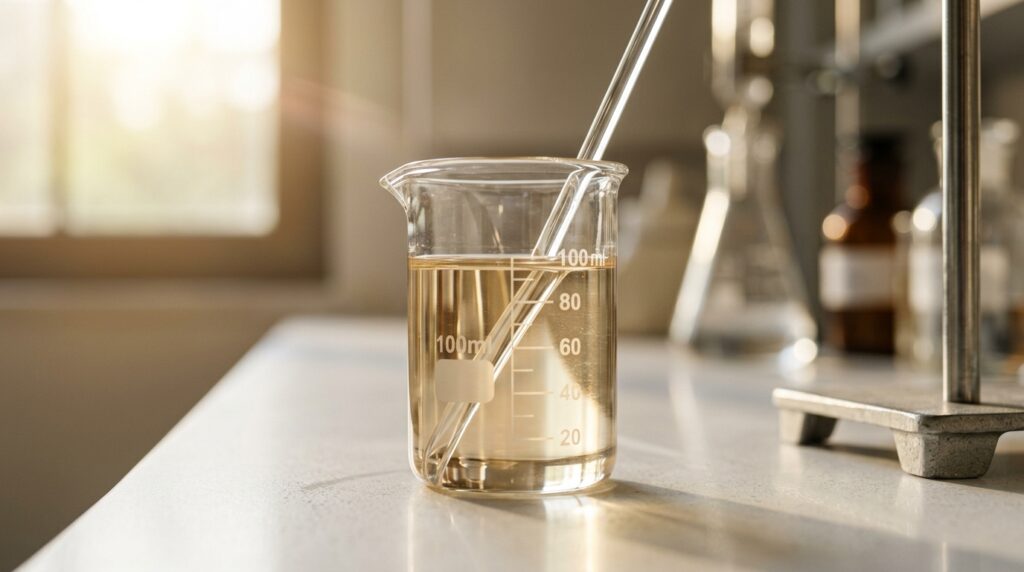
Ceramides are the structural lipid most associated with a healthy skin barrier, but ceramides skincare formulation is harder than the marketing suggests. The molecule that performs beautifully in vivo is the same molecule that crystallizes in your emulsion at room temperature, refuses to dissolve below 75°C, and degrades barrier function when added without its lipid partners.
This guide is built for R&D chemists and product development teams making real bench decisions. It covers ceramide class selection, the 3:1:1 ceramide-cholesterol-fatty acid ratio, solubility and processing parameters, emulsifier and pH compatibility, preservative pairing, and the choice between free lipid and liposomal delivery.
Key Takeaways
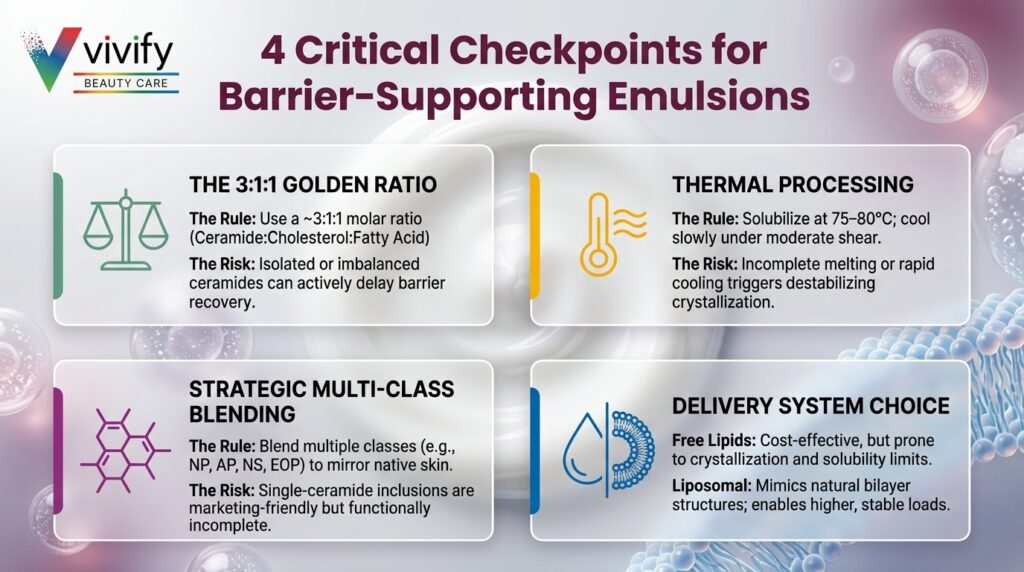
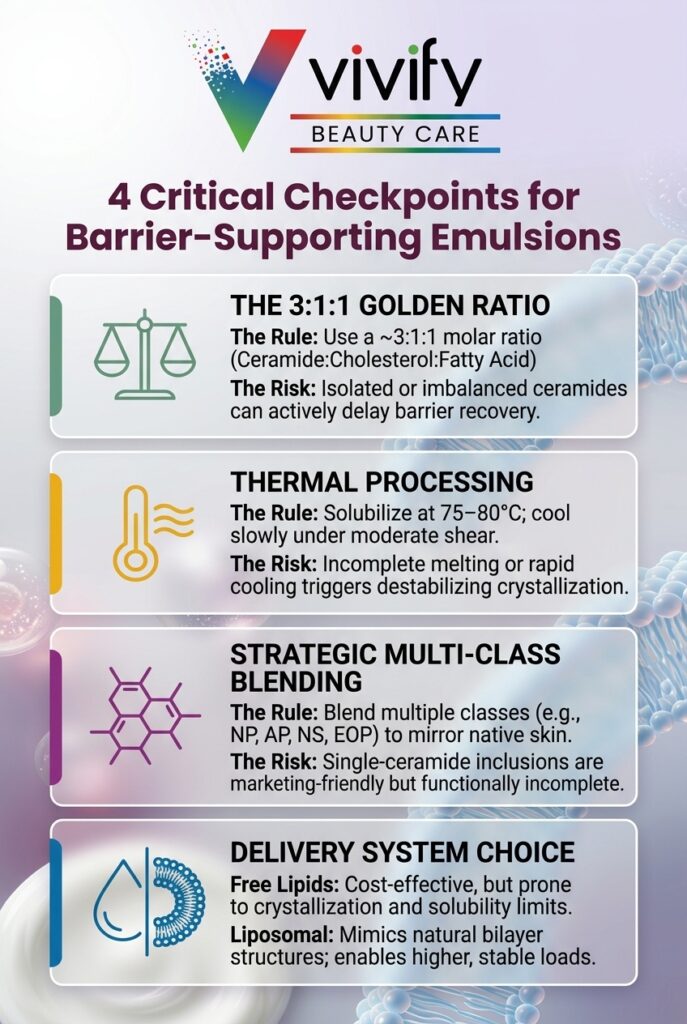
- Ceramides cannot be formulated alone. Applied without cholesterol and free fatty acids in roughly a 3:1:1 molar ratio, physiologic lipid mixtures can delay or worsen barrier recovery rather than support it.1,6
- Six classes are formulation-relevant: NP, AP, EOP, EOS, AS, and NS. Each contributes differently to lamellar organization in the stratum corneum, where at least eleven distinct ceramide classes have been characterized.3
- Ceramide NP and other long-chain ceramides typically require oil-phase temperatures of 75–80°C for full solubilization, slow controlled cooling to prevent recrystallization, and careful HLB matching with the chosen emulsifier system.
- Liposomal and lamellar delivery systems address the solubility and crystallization limits of free ceramide. Optimized ceramide NP liposomes have been formulated at approximately 137 nm particle size with high encapsulation efficiency and lipid organization similar to healthy stratum corneum.4
- Avoid overgeneralized ‘ceramide deficiency’ claims. Ceramide profiles in non-lesional atopic dermatitis and psoriasis skin can be comparable to healthy controls; deficits show up in lesional skin and in specific long-chain species, not as a uniform global drop.5
What Ceramides Do in the Stratum Corneum
Ceramides are sphingolipids that make up roughly half of the intercellular lipid mass of the stratum corneum, where they organize alongside cholesterol and free fatty acids into the lamellar bilayers that govern transepidermal water loss (TEWL). Topically applied physiologic lipids, in the correct ratio, are absorbed into nucleated epidermal layers and incorporated into nascent lamellar bodies; they do not simply sit on the surface as occlusives do.6
This distinction matters at the formulation table. A barrier-mimicking ceramide product is a delivery vehicle for lipids the skin uses to rebuild its own barrier, which is why ratio, lipid identity, and processing all influence whether the finished product performs as intended.
One nuance to preserve in product positioning: ceramide deficiency is not uniform across compromised skin states. Ceramide profiles in non-lesional skin of atopic dermatitis and psoriasis patients have been shown to be comparable to those of healthy skin.5 The deficit pattern shows up in lesional skin and in specific long-chain species. Avoid framing barrier products as universal correctors of a global ceramide drop.
The Six Ceramide Classes That Matter for Formulation
Human stratum corneum contains at least eleven ceramide classes, distinguished by their sphingoid base and fatty acid head groups.3 For most cosmetic formulations, six classes drive the bulk of formulator decision-making. Understanding what each class contributes is the first step in choosing a barrier-mimicking blend rather than a single-ceramide claim ingredient. The table below summarizes the six formulation-relevant classes:
| Class | INCI / Common name | Structural role | Formulation note |
| NP | Ceramide NP (formerly Ceramide 3) | Most abundant ceramide class in healthy stratum corneum; backbone of barrier lamellae. | The default starting point for barrier-mimicking blends. Solubility and crystallization control are the primary formulation challenges. |
| AP | Ceramide AP (formerly Ceramide 6 II) | α-hydroxy fatty acid head group; supports lamellar packing and hydration. | Frequently paired with NP in finished products. Slightly better solubility behavior than EOP-class ceramides. |
| EOP | Ceramide EOP (formerly Ceramide 1) | Ester-linked omega-hydroxy ceramide; critical for long-periodicity lamellae. | Long chain, hydrophobic, harder to solubilize. Often added at lower percentages than NP/AP. |
| EOS | Ceramide EOS | Long-chain omega-O-acyl ceramide; contributes to barrier cohesion. | Less common in cosmetic INCI listings but present in advanced barrier-mimicking systems. |
| AS | Ceramide AS (formerly Ceramide 5) | Sphingosine + α-hydroxy fatty acid; broad presence across stratum corneum lipid profile. | Often paired in three- or four-ceramide blends to broaden lamellar coverage. |
| NS | Ceramide NS (formerly Ceramide 2) | Sphingosine + non-hydroxy fatty acid; second-most abundant class in many profiles. | Useful in NP-NS-EOP combinations that mirror native lamellar composition more closely than NP alone. |
Picking a single ceramide and labeling a product ‘with ceramides’ is technically accurate but functionally weak. A blend that mirrors the dominant native classes (NP, NS, AP, with EOP at lower load) gives the lamellar organization a closer match to what the skin already builds. Vivify’s ceramides and lipid actives portfolio includes individual ceramide classes and pre-blended barrier-mimicking systems that pair common ceramide combinations with the cholesterol and free fatty acid co-actives the next section addresses.
The 3:1:1 Ratio: Why Ceramides Cannot Be Formulated Alone
Ceramides delivered without cholesterol and free fatty acids in approximately a 3:1:1 molar ratio do not function as a barrier therapy. The foundational paper by Man, Feingold, Thornfeldt, and Elias established that an optimized 3:1:1 ratio of ceramides to cholesterol to free fatty acids accelerates barrier recovery in murine models, while equimolar (1:1:1) and lipid-incomplete mixtures delay or worsen recovery.1
This is the formulation point most consumer-facing ceramide content gets wrong. The position is unambiguous in the dermatology literature: ceramides applied in isolation can be counterproductive.
“if the ceramide is provided without the addition of the other 2 key physiological lipids at an appropriate ratio (ie, with cholesterol and 1 or more free fatty acids), barrier function deteriorates rather than improves.”
Peter M. Elias, MD, Department of Dermatology, University of California San Francisco and San Francisco VA Medical Center.6 The same review notes that triple-lipid therapies at the optimized ratio have demonstrated clinical efficacy in pediatric atopic dermatitis comparable to a fluorinated mid-potency steroid.6
When the 3:1:1 Ratio Can Be Modified
The 3:1:1 ratio is the optimized starting point, not a rigid rule. The original Man et al. work tested several ratios and identified 3:1:1 as most effective; ratios in which any single lipid dominated produced inferior results.1 Practical adjustments formulators consider:
- Shifting toward higher cholesterol in formulations targeting aged skin, where cholesterol synthesis declines.
- Adjusting free fatty acid identity. Linoleic, palmitic, and oleic acids behave differently in lamellar organization and finished-product feel.
- Layering humectants. The ratio governs the lipid phase; the aqueous phase still does the water-pulling work, which is where pairing with moisturizing and hydration actives matters.
Changes outside the established ratio range should be tested in vivo before becoming central to a product claim, since deviating from the 3:1:1 starting point moves a formulation outside the strongest published evidence base for barrier repair.
Practical Implications for Product Positioning
The ratio rule directly shapes how a finished product can be marketed. A formulation that includes ceramides alongside cholesterol and free fatty acids in the established ratio supports barrier-repair, barrier-restore, and barrier-mimicking positioning with published evidence behind the claim. A formulation containing ceramides alone, or ceramides at a ratio that deviates substantially from 3:1:1, does not have the same evidence base. Single-ceramide products can still be valid moisturizers; they are simply not interchangeable with triple-lipid barrier-repair systems from a claims standpoint.
Solubility, Processing Temperatures, and Crystallization Control
Ceramides are crystalline solids with high melting points, and they do not dissolve in cold or warm oil phases. Practical processing parameters most formulators converge on:
- Oil-phase target temperature of 75–80°C, held long enough to fully solubilize all ceramides into the carrier lipid system. Inadequate hold times leave undissolved crystallites that re-nucleate during cooling.
- Use of a cosolvent or compatible carrier oil. Caprylic/capric triglyceride, isopropyl myristate, dicaprylyl carbonate, and squalane are common starting points; emollient and moisturizer functional ingredients can be screened for solubilization performance before lipid loading is fixed.
- Slow, controlled cooling under continued moderate shear from solubilization temperature to roughly 40°C. Rapid cooling promotes crystallite formation; slow cooling allows the ceramide-cholesterol-fatty acid system to organize into desired lamellar structures.
- Stability evaluation that explicitly checks for crystallization. Microscopy at 1, 4, and 12 weeks at room temperature, 40°C, and 4°C catches recrystallization that is not visible to the naked eye but degrades sensory and barrier performance.
Crystallization is the single most common ceramide formulation failure. The two recurring root causes are insufficient solubilization temperature and excessive ceramide loading relative to the carrier system. Both are catchable in early development.
Emulsifier Selection and HLB Matching for Ceramide Systems
Ceramide-loaded oil phases are heavy, nonpolar, and viscous, which narrows the emulsifier options that produce stable, elegant emulsions. HLB matching to the carrier lipid system is the starting point. Most ceramide barrier creams sit in an O/W architecture with a required HLB in the 8–11 range, depending on the carrier oil blend.
Common emulsifier system choices that work well with ceramide oil phases:
- Polyglyceryl ester systems (e.g., polyglyceryl-3 methylglucose distearate, polyglyceryl-10 stearate) for PEG-free positioning. Stable across pH 4–7 and compatible with cholesterol and free fatty acid co-actives.
- Glyceryl stearate / PEG-100 stearate combinations for cost-efficient, well-documented behavior in barrier creams. Compatible with most preservative systems.
- Cetearyl glucoside / cetearyl alcohol blends for liquid crystal–forming systems that can support lamellar organization without explicit liposomal delivery.
Higher ceramide percentages typically require higher emulsifier load to maintain droplet size and stability, which compounds the HLB calculation. Vivify’s emulsifier systems catalog includes the polyglyceryl, glyceryl stearate, and glucoside-based options most commonly screened for barrier-cream applications, and the companion guide on selecting an emulsifier system walks through architecture choice (O/W, W/O, W/Si) in more detail.
pH Stability, Preservative Compatibility, and Other Formulation Constraints
Ceramides are stable across the pH range typical of leave-on skincare, roughly pH 4–7. They do not require the tight pH windows that vitamin C derivatives or hydroxy acids do, which simplifies formulation but does not eliminate compatibility constraints.
pH Considerations
- Ceramides themselves are pH-stable in the 4–7 range. Below pH 4, prolonged exposure can promote slow hydrolysis of the amide bond, which is why ceramides are not generally combined into low-pH AHA formulations as the primary active.
- Cholesterol and free fatty acid co-actives are similarly pH-stable. Free fatty acids can ionize above pH 7 and shift functional behavior, which is why barrier creams typically target pH 5.5–6.5.
- If ceramides are paired with a low-pH active in the same product, consider physical separation (two-phase system) or shift the ceramide-bearing system into a separate product step.
Preservative Compatibility
Ceramide-loaded emulsions are nutrient-rich and warm-processed, which makes microbial control non-negotiable. Preservative pairing matters for both efficacy and finished-product stability:
- Phenoxyethanol-based systems pair reliably with ceramide emulsions across pH 4–7. Ethylhexylglycerin co-preservation is common.
- Organic acid systems (e.g., benzoic acid, sorbic acid) require pH below 5.5 to stay in their active acid form, which conflicts with the barrier-cream pH target. Use only if the formulation pH supports activity.
- Avoid strongly cationic preservatives in ceramide systems containing free fatty acids; ionic interactions can compromise both preservative efficacy and lamellar organization.
Vivify’s preservative and antimicrobial systems portfolio covers PEG-free, paraben-free, and broad-spectrum options that have been screened for compatibility with lipid-rich systems. From a regulatory standpoint, the CIR Expert Panel safety assessment concluded that ceramides as used in cosmetics are safe in current practices of use and concentration, which removes ceramide-specific safety as a constraint and lets formulators focus on system-level preservative compatibility.
Free Lipid vs. Liposomal/Lamellar Delivery: How to Choose
The choice between formulating ceramides as free lipids in a conventional emulsion versus pre-encapsulated in a liposomal or lamellar delivery system is a trade-off between solubility headaches and cost. Both approaches can produce effective barrier-repair products. The decision usually comes down to ceramide loading, target sensory, and processing capability.
Free Lipid Approach
Conventional approach: solubilize ceramides into the oil phase at 75–80°C, emulsify, and rely on the finished cream architecture to deliver the lipids to the stratum corneum.
- Strengths: lower raw material cost, formulation flexibility, well-documented behavior in O/W and W/O systems, easier to combine with the 3:1:1 ratio of cholesterol and free fatty acids.
- Limitations: solubilization temperature requirement, crystallization risk, ceiling on ceramide loading before sensory and stability degrade.
Liposomal and Lamellar Delivery
Pre-encapsulated approach: ceramides are loaded into phospholipid bilayers or non-ionic vesicles before incorporation into the finished product. Şahin Bektay et al. used response surface methodology to design ceramide NP-loaded liposomes optimized at a particle size of 136.6 nm with 93.8% encapsulation efficiency and an in vitro release profile fitting the Korsmeyer-Peppas sustained-release model; lipid chain organization in the optimized vesicles resembled the orthorhombic packing of healthy stratum corneum lipids, supporting their potential as a barrier-restoration delivery system.4
- Strengths: bypasses bulk-phase solubility limits; supports cold-process or low-energy emulsification; can carry higher effective ceramide load with reduced crystallization risk; vesicle structure can mimic the lamellar architecture of native stratum corneum lipids.
- Limitations: higher raw material cost; vesicle stability is a separate evaluation step; co-formulation with cholesterol and free fatty acids requires planning so the 3:1:1 ratio is preserved across both encapsulated and free phases.
For brands building a hero claim around barrier repair, liposomal or lamellar delivery often justifies the cost. For broad-portfolio moisturizers where ceramide is a supporting ingredient at lower load, free lipid formulation is usually the right answer. Vivify’s delivery systems portfolio includes vesicular and lamellar carriers that can be screened against the target ceramide load and finished-product format.
Formulating Ceramides Alongside Other Actives
Ceramides rarely appear alone in finished products. They show up alongside peptides, retinoids, exfoliants, and conditioning systems, each of which introduces compatibility considerations:
- Peptides: Ceramides pair well with most peptide actives, particularly signal peptides that benefit from a stable lipid carrier. See the companion post on peptide formulation for detailed compatibility considerations.
- Retinoids: Retinoids disrupt barrier function during early use, which is why ceramide pairing is now standard in retinoid serums and creams. The retinoid formulation guide covers retinoid stabilization; from the ceramide side, the constraint is preserving the 3:1:1 lipid ratio in a system that may also require encapsulation of the retinoid.
- Hydroxy acids: Ceramides as a barrier-restoration adjunct in AHA, BHA, and PHA systems are a defensible product position, but pH separation matters. See the AHA, BHA, and PHA formulation guide for pH targets; ceramides are typically delivered in a separate product step or in a phase-separated system rather than directly in the acid phase.
- Surfactant systems: Ceramides in cleansers and other rinse-off products require different formulation logic than leave-ons; deposition rather than emulsion stability is the dominant constraint. The cosmetic surfactants guide covers cleanser surfactant chemistry.
- Anti-aging adjuncts: Stratum corneum ceramide content declines with age, which is why ceramides are frequently paired with anti-aging and anti-wrinkle actives in mature-skin product lines. A ceramide-containing cream formulated to mimic the natural lipid barrier produced significantly greater skin hydration than three reference over-the-counter moisturizers at 24 hours post-application and significantly decreased TEWL versus baseline.2
Frequently Asked Questions About Ceramides Skincare Formulation
What temperature should the oil phase reach to fully solubilize ceramide NP?
75–80°C, held until the system is visually clear and free of undissolved crystallites. Holding the oil phase at 75°C for 15–20 minutes under moderate agitation is a common starting protocol. Inadequate solubilization is the most frequent root cause of post-cooling crystallization in ceramide products. If clarity is not achieved at 80°C, screen for a more compatible carrier oil rather than pushing the temperature higher.
Can ceramides be formulated alone, without cholesterol and free fatty acids?
They can be incorporated alone, but applied without cholesterol and one or more free fatty acids in roughly a 3:1:1 molar ratio, the published evidence indicates barrier function can deteriorate rather than improve.1,6 If a product is positioned around barrier repair or barrier support, the 3:1:1 ratio is the established standard. If ceramides are a secondary ingredient in a broader moisturizer claim, single-ceramide inclusion is acceptable but should not be marketed as barrier-restoring.
How do you prevent ceramide crystallization in cooled emulsions?
Crystallization control comes from three controllable variables: complete solubilization at 75–80°C, slow controlled cooling from solubilization temperature down to about 40°C under continued moderate shear, and ceramide load that is conservative relative to the carrier oil system’s solvating capacity. Microscopy at 1, 4, and 12 weeks across 4°C, room temperature, and 40°C catches recrystallization early. Liposomal or lamellar delivery is the most reliable path around the bulk-phase solubility ceiling for high-load formulations.4
What pH range maintains ceramide stability in finished products?
Ceramides are stable across pH 4–7, which covers the typical leave-on skincare range. Most barrier creams target pH 5.5–6.5 to match the surface pH of skin and to keep free fatty acid co-actives in their non-ionized form. Below pH 4, prolonged exposure can drive slow hydrolysis of the ceramide amide bond, which is why ceramides are not generally combined directly into the acid phase of low-pH AHA or BHA formulations as the primary active.
Build Better Ceramide Formulations With Vivify
Ceramides reward formulators who treat them as a structural lipid system, not a single ingredient. Class selection, ratio with cholesterol and free fatty acids, processing temperature, emulsifier compatibility, and delivery format all influence whether the finished product delivers the barrier-mimicking performance the label promises.
Looking to evaluate ceramides, lipid co-actives, or pre-blended barrier-mimicking systems for your next launch? Explore Vivify’s formulation and lab support or talk to our technical team about samples, prototype kits, and class-by-class selection for your target product.
References
- Man, M. Q., Feingold, K. R., Thornfeldt, C. R., & Elias, P. M. (1996). Optimization of physiological lipid mixtures for barrier repair. Journal of Investigative Dermatology, 106(5), 1096–1101. https://pubmed.ncbi.nlm.nih.gov/8618046/
- Spada, F., Barnes, T. M., & Greive, K. A. (2018). Skin hydration is significantly increased by a cream formulated to mimic the skin’s own natural moisturizing systems. Clinical, Cosmetic and Investigational Dermatology, 11, 491–497. https://doi.org/10.2147/CCID.S177697
- Suzuki, M., Ohno, Y., & Kihara, A. (2022). Whole picture of human stratum corneum ceramides, including the chain-length diversity of long-chain bases. Journal of Lipid Research, 63(7), 100235. https://doi.org/10.1016/j.jlr.2022.100235
- Şahin Bektay, H., Sağıroğlu, A. A., Bozali, K., Güler, E. M., & Güngör, S. (2023). The design and optimization of ceramide NP-loaded liposomes to restore the skin barrier. Pharmaceutics, 15(12), 2685. https://doi.org/10.3390/pharmaceutics15122685
- Farwanah, H., Raith, K., Neubert, R. H. H., & Wohlrab, J. (2005). Ceramide profiles of the uninvolved skin in atopic dermatitis and psoriasis are comparable to those of healthy skin. Archives of Dermatological Research, 296(11), 514–521. https://doi.org/10.1007/s00403-005-0551-2
- Elias, P. M. (2022). Optimizing emollient therapy for skin barrier repair in atopic dermatitis. Annals of Allergy, Asthma & Immunology, 128(5), 505–511. https://doi.org/10.1016/j.anai.2022.01.012