Key Takeaways
- Organic vs inorganic filters each have distinct strengths. Organic (chemical) filters excel at delivering high SPF with lightweight, elegant textures. Inorganic (mineral) filters are valued for low irritation and sensitive-skin compatibility, with modern processing reducing white cast.
- Regulation and region shape what you can launch – and how you talk about it. Differences between US (FDA OTC), EU (cosmetics), and other regions impact which filters you can use, how you support SPF/broad-spectrum claims, and how you position “reef‑friendly,” “clean,” endocrine, and nano-related topics.
- Operational and supply realities matter as much as the chemistry. Cost volatility, filter availability, and regional restrictions mean you need modular formulations, multiple suppliers, and cross‑functional planning to maintain speed‑to‑market and scalability.
- Your UV filter choice should match your brand archetype. Clean/natural brands often lean mineral or mineral‑forward, luxury brands prioritize sensory excellence, and mass brands focus on cost‑efficient, trusted filters – all while meeting safety and regulatory requirements.
In today’s dynamic beauty landscape, selecting the ideal UV filter is both a strategic and technical decision. For brands ranging from indie innovators to global leaders, choosing between organic (chemical) and inorganic (mineral) UV filters can shape formulation performance, sensory experience, regulatory compliance, and even consumer perception. This comprehensive guide provides clear, actionable insights to help align your UV filter choices with performance targets, market aspirations, and evolving consumer demands.
Understanding the UV Filter Landscape
UV filters are key active ingredients in sunscreen and personal care formulations. Their primary role is to protect skin from UVA and UVB radiation, supporting reduced UV-driven skin damage and visible photoaging over time.1–3 However, the decision between organic and inorganic UV filters extends beyond mere protection. Your choice can influence brand positioning, speed-to-market, cost structures, claims substantiation, and supply chain stability.
If you’re mapping your UV strategy to an ingredient roadmap, Vivify’s UV protection/defense actives and broader antioxidant actives can help round out a sun care concept beyond UV filters alone.
Defining Organic (Chemical) UV Filters
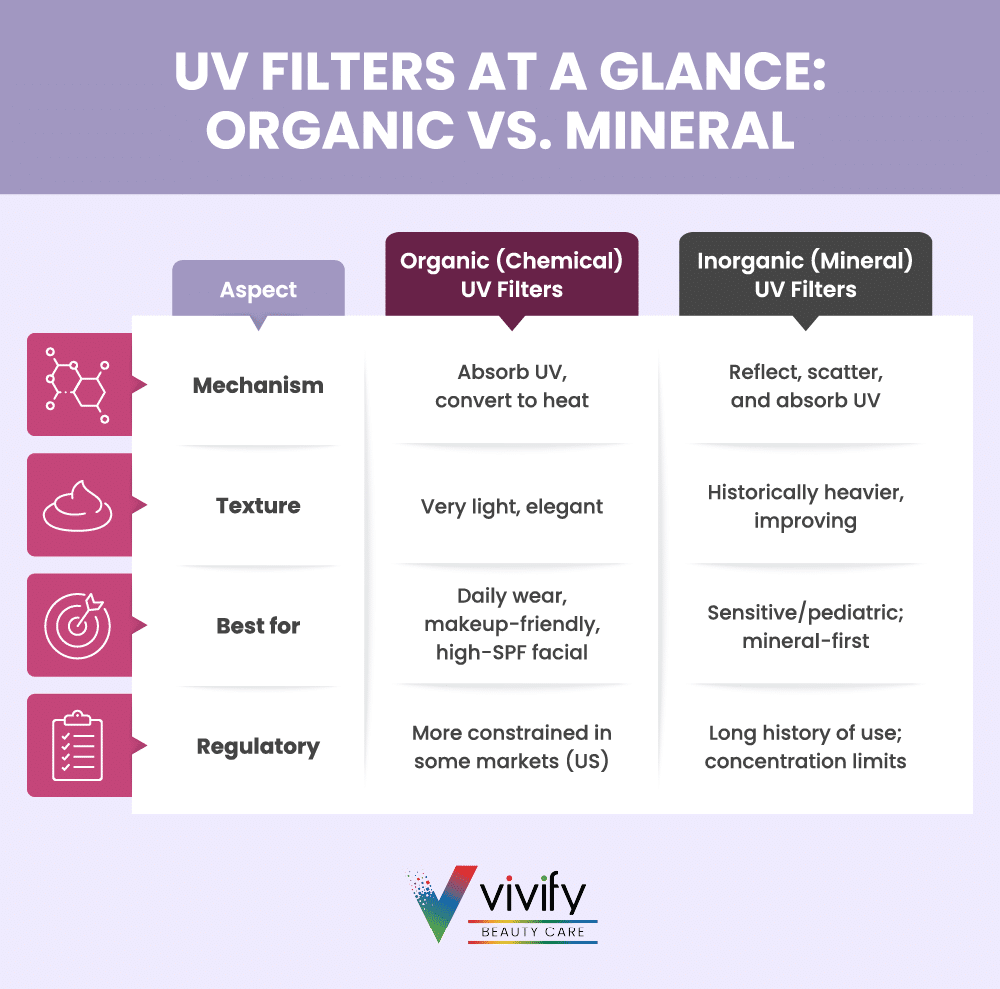
Organic UV filters are carbon-based compounds engineered to absorb UV radiation and dissipate that energy (often as heat) through photophysical relaxation pathways.4 This mechanism can provide:
- High SPF values with comparatively efficient UV protection per percentage of active, depending on the specific filters and vehicle used.4
- High SPF values with relatively lower concentrations of active ingredients, depending on the filter set and overall optical design.4
- A lightweight, “barely there” sensory finish that many consumers appreciate.
- Opportunities to combine multiple active compounds for broad-spectrum protection without notably affecting texture.4
Modern UV filter design and stabilization strategies have improved photostability for many organic systems, helping maintain protection under UV exposure (especially when appropriate stabilizers, filter pairings, and vehicles are used).11,12 Although these innovations support performance, reapplication remains necessary because real-world effectiveness depends heavily on application amount, wear, and environmental exposure.13–15
It is important to note that while product development continues to evolve, specific formulations may vary widely, and product claims should be interpreted with these practical considerations in mind.
Defining Inorganic (Mineral) UV Filters
Inorganic UV filters, most notably titanium dioxide and zinc oxide, are derived from mineral sources and attenuate UV primarily through absorption, with scattering and reflection contributions that depend on particle size, dispersion quality, and surface treatment.5,6 Their key attributes include:
- Often selected for sensitive or compromised-skin positioning because they can be well tolerated in many leave-on systems when properly formulated.4,6
- A perception among some consumers of being more “natural,” even though this view is based on their mineral origins rather than an inherent naturalness.
- A long-established track record of use in pediatric and sensitive-skin formulas, alongside generally limited skin penetration in intact skin; for zinc oxide, small amounts of zinc can be absorbed systemically as dissolved zinc rather than as particles.7,8
Although early inorganic filters were known for a heavier texture and visible white cast, advances in particle engineering, coating technologies, and optimized dispersion have improved aesthetics and performance, including reduced opaqueness and better UVA/UVB balancing in many systems.6
Performance & Sensory: Film Formation, Stability, User Experience

How UV filters are delivered in the formula is as important as which filters you choose. Film formation, stability, and texture together determine real-world protection and user acceptance.13–15
Film Formation and Coverage
A uniform, continuous film is key for reliable SPF because gaps, streaking, and low application density reduce delivered protection versus labeled values.13,14
- Organic (chemical) filters: When paired with suitable emollients and film formers, organic filters can support thin, even films that help achieve high SPF at cosmetically acceptable active levels.4,13
- Inorganic (mineral) filters: Well-dispersed titanium dioxide and zinc oxide can attenuate UV effectively; good dispersion helps reduce agglomeration, supporting more uniform coverage and improved aesthetics.6
For formulation support, Vivify’s film formers & fixatives and dispersing agents can be useful tools when you’re optimizing film integrity, pigment/mineral dispersion, and wear.
Sensory Experience and Skin Compatibility
- Organic systems are often favored for lightweight, fast-absorbing textures that layer well with skincare and makeup.
- Inorganic systems are frequently positioned for low-irritation and sensitive-skin use cases, with evidence supporting limited penetration of titanium dioxide particles through intact skin and low systemic uptake risk under typical use; for zinc oxide systems, low-level systemic zinc uptake can occur primarily as ions rather than as particles.7,8
- Advances in particle engineering and coatings have also reduced white cast, improving wearability.6
Stability and Real-World Use
- Modern organic filter systems, appropriate filter pairings, and stabilizing approaches can improve photostability under UV exposure, helping reduce UV-driven degradation in susceptible filters (e.g., avobenzone) in poorly stabilized systems.11,12
- Surface-treated and well-dispersed inorganic filters can help maintain stability and reduce unwanted photoreactivity (including mitigation of photocatalytic behavior in certain metal oxide grades).6
- Regardless of filter type, reapplication remains essential because real-world behaviors (application amount, water exposure, friction/rubbing) affect delivered protection more than lab conditions. Comfort-forward, non-greasy textures support better user compliance and, ultimately, better protection.13–15
Beyond UV filters themselves, brands often rely on supporting ingredients to optimize feel, wear, deposition, and stability.
If you’re exploring non-filter support ingredients to improve sensory feel, film integrity, deposition, and stability, Vivify’s sun care functional ingredients and ingredient delivery systems can help you engineer sensory, deposition, and stability goals across formats. For brands evaluating botanical booster concepts, Vivify’s AccessCARE SUN-S is one example positioned to complement UV protection strategies (work with your team to validate performance and claims in your specific base and UV system).
Regulatory & Claims: US vs EU and Beyond
UV filter choice is closely tied to regional regulations and on-pack claims. Differences between the U.S., EU, and other markets affect which organic vs mineral UV filters you can use and how you can speak about safety and environmental impact.
Claims Support and Emerging Concerns
Across regions, marketing claims must be evidence-based and aligned with local rules:
- SPF and broad-spectrum claims: Typically require recognized in vivo and/or in vitro testing, with documentation showing UVA and UVB performance plus clear directions for use.
- “Reef-friendly” and environmental positioning: Certain jurisdictions have restricted the sale of sunscreens containing specific organic UV filters (notably oxybenzone and octinoxate). There is no globally harmonized definition of “reef-safe,” so brands are safer framing claims around regulatory compliance and reduced environmental impact rather than absolute “reef-safe” guarantees.
- “Clean,” endocrine, and nano considerations: Terms like “clean” or “conscious” are marketing descriptors, not regulatory categories. Some organic UV filters have been investigated for endocrine-related activity across experimental models, underscoring the importance of using permitted filters within established concentration limits and building robust safety rationales for your specific use case.16 Nano-sized mineral filters can face additional scrutiny in some regions, including specific safety assessments and labeling requirements.
Brands should communicate safety responsibly — emphasizing compliance and substantiated safety assessments without implying that competitors are unsafe.
Key Regional Frameworks
United States (FDA)
- Sunscreens are regulated as OTC drugs under the FDA monograph.
- A defined list of approved UV filters, maximum concentrations, and detailed labeling rules shape which organic and inorganic actives you can use and how you present SPF, broad-spectrum protection, water resistance, and directions.
European Union
- Sunscreens are regulated as cosmetics within a strict safety and ingredient review framework.
- Both organic and inorganic filters are used, governed by concentration limits, purity criteria, and nano-specific rules, including [nano] labeling where applicable.
- Several organic filters have been, or are being, reassessed for safety (including potential endocrine effects), which can lead to revised limits or conditions of use.
Other Regions (APAC, Latin America, etc.)
- Many markets maintain their own approved filter lists, testing requirements, and environmental priorities.
- Some emphasize very high UVA protection or specific filters; others focus on reef-related issues or nano materials. These differences can influence whether you lean more heavily on mineral or organic UV filter systems.
Keeping abreast of these regulatory landscapes, and aligning your UV filter strategy, safety dossier, and claims accordingly, helps reduce the risk of reformulation and supports a smoother path for regional or global launches.
Regional Consumer Insights: North America & Europe
Building on the regulatory context above, regional consumer expectations in North America and Europe further shape how brands choose between organic (chemical) and mineral (inorganic) UV filters. Understanding how these markets differ can help you tailor both formulation priorities and messaging.
North America
In North America, consumers often prioritize ease-of-use and multifunctionality:
- Product formats & sensorials: Lightweight, fast-absorbing textures that layer well under makeup or daily skincare are strongly favored. Multifunctional sunscreen formats (e.g., moisturizer + SPF, primer + SPF) are widely accepted.
- Filter preferences: Many consumers appreciate the comfort and spreadability of organic (chemical) filters. At the same time, a growing segment (especially parents and “clean beauty” shoppers) seek mineral-only or mineral-forward options, even if those may involve some trade-off in texture or white cast.
- Regulatory lens: Within current U.S. constraints, brands often rely on a focused set of approved filters and differentiate through texture, format, and claims language.
For brands, this often means:
- Designing everyday-wearable textures that encourage higher compliance and more adequate application amounts.13,14
- Clearly communicating broad-spectrum protection, skin benefits, and how the product fits into a simple routine.
- Positioning mineral systems thoughtfully for sensitive skin and “conscious” consumers without over-promising on environmental claims.
Europe
European markets tend to emphasize refined textures, strong regulatory compliance, and a more “cosmetic” sunscreen experience:
- Product expectations: Consumers frequently look for sunscreens that deliver a luxurious feel, elegant finish, and compatibility with sophisticated skincare routines. Creams, fluids, and milks with advanced emulsification are common.
- Filter preferences: A broader portfolio of approved organic UV filters in many EU contexts can enable high-SPF, high-UVA protection with elegant sensorial profiles. Inorganic filters such as titanium dioxide and zinc oxide are used within defined rules.
- Regulatory lens: Given strict safety and labeling requirements (including for some organic filters and nano minerals), brands typically emphasize texture engineering and precise, compliant claims.
For brands, this often translates to:
- Investing in texture engineering (emulsifiers, film formers, and silicones or alternatives) to deliver premium aesthetics.
- Ensuring that claims and INCI choices align tightly with EU expectations and regional stances on certain UV filters and marketing language.
For brands planning global launches, understanding how North American and European consumers perceive chemical vs mineral sunscreen filters is essential to choosing the right UV filter mix and positioning it effectively in each market.
Operational Considerations: Cost, Supply, and Speed-to-Market
Beyond performance and positioning, practical factors like cost, supply stability, and launch timelines strongly influence how you work with organic or inorganic UV filter systems.
Cost and Raw Material Volatility
Organic filters are produced via specialized chemical synthesis and can be affected by fluctuations in precursor availability, energy costs, and regulatory-driven demand shifts. Inorganic filters such as titanium dioxide and zinc oxide are linked to mining outputs, global commodity pricing, and any regulations impacting their use (e.g., nano restrictions).
To manage cost:
- Prioritize widely used, well-supported filters where possible to benefit from economies of scale.
- Use modular formulations so that minor filter substitutions won’t require a full rebuild if an input becomes cost-prohibitive.
Supply Chain and Regulatory Variability
Regulatory differences can complicate sourcing and continuity:
- Some markets restrict specific organic filters (reef-related restrictions or safety reviews), while others apply nano-specific rules to mineral filters.
- A formula that works smoothly in one region may require filter swaps or level adjustments elsewhere.
To build resilience:
- Qualify multiple suppliers for critical UV filters and key auxiliaries (dispersants, film formers).
- Design base formulations that can accommodate region-specific “filter modules” (e.g., one UV system for US, another for EU/APAC) without changing the overall product identity.
Speed-to-Market and Cross-Functional Collaboration
Complex UV regulations and performance requirements make early alignment essential:
- Involve R&D, regulatory, quality, and marketing from the start to avoid late-stage changes in filters, claims, or packaging.
- Engage with technical reps from UV filter suppliers early to understand regional approvals, typical use levels, and stability considerations.
- Build in decision checkpoints (e.g., initial filter shortlist, regional feasibility review, pre-stability lock) to move quickly while reducing risk.
By addressing cost, supply stability, and regulatory variability together, you can choose UV filter systems that are not only effective and on-brand, but also scalable and sustainable as you expand into new markets.
Aligning UV Filter Choice with Brand Positioning

Your mix of organic or mineral UV filters should support how you want your brand to be perceived.
Clean / Natural-Leaning Brands
- Tend to favor mineral or mineral-forward systems (zinc oxide, titanium dioxide).
- Emphasize “gentle” and “sensitive-skin friendly,” with cautious, compliant use of “reef-conscious” or similar language.
Derm / Clinical Brands
- Often prioritize strong UVA/UVB protection and photostability, supported by robust testing and a conservative claims approach.11,12
- Lean on testing (e.g., broad-spectrum, sensitive-skin, sometimes clinicals) to support claims.
Luxury / Prestige Brands
- Prioritize texture and finish, typically via elegant organic filter systems that deliver high SPF with a weightless feel.4
- Focus messaging on invisible protection, comfort, and compatibility with sophisticated skincare and makeup routines.
Mass / Accessible Brands
- Rely on cost-efficient, widely approved filters and familiar formats (cremes, lotions, or sticks).
- Highlight reliability, ease of use, and clear directions for family or everyday use.
By intentionally linking your UV filter choice to your brand archetype, you create sunscreens that are not only technically sound but also aligned with your story and target consumer expectations.
Putting It All Together: A Holistic UV Filter Strategy
- Align Filter Choice with Brand DNA: Whether your brand positions itself as high-tech, naturally oriented, or universally accessible, select UV filters that reinforce your core values. For some, this may mean highlighting the gentle positioning and limited penetration evidence associated with well-formulated inorganic systems; for others, lightweight sensorial performance from advanced organic systems may be central to the brand story.4,7,8
- Integrate Regulatory and Claims Planning: Ensure that every marketed claim, ranging from “reef-friendly” to “broad-spectrum protection”, is backed by appropriate testing and regulatory documentation.
- Prioritize Sensory and Aesthetic Factors: Product appearance and feel play a crucial role in consumer acceptance. Investing in advanced dispersion methods or film-forming systems can materially improve sensory performance while supporting more uniform coverage and more consistent real-world protection.6,13,14
- Build a Resilient Supply Chain: Diversify suppliers and adopt flexible formulation strategies to mitigate raw material volatility and regulatory changes. Strengthening these aspects from the outset helps ensure continuous product availability and consistent performance.
- Speed-to-Market with Agile Processes: Early collaboration between R&D, regulatory, and marketing teams facilitates rapid product development and launch. This agility is essential for meeting evolving consumer needs, particularly in a competitive market landscape.
FAQs: Organic vs Inorganic UV Filters for Beauty Brands
What’s the difference between organic (chemical) and inorganic (mineral) UV filters?
Organic filters are carbon-based molecules that mainly absorb UV and dissipate energy through photophysical pathways (often perceived as “converting to heat”); inorganic filters (zinc oxide, titanium dioxide) attenuate UV primarily by absorption with additional scattering/reflection contributions that depend on particle properties and dispersion quality.4–6
Are mineral (inorganic) UV filters always safer or more “natural” than chemical filters?
No. Both organic and inorganic UV filters permitted by regulators are evaluated for safety within defined limits. Mineral filters are often perceived as more “natural,” but they are processed ingredients, not raw minerals. Evidence also shows that systemic absorption has been demonstrated for multiple organic UV filters under maximal-use conditions, while titanium dioxide shows limited penetration in intact skin and zinc oxide can lead to low-level systemic zinc uptake primarily as ions.7–10
Which UV filter strategy works best for sensitive or compromised skin?
Mineral systems are commonly favored for sensitive, reactive, or pediatric positioning due to tolerability profiles and evidence supporting limited particle penetration through intact skin; zinc oxide systems may still contribute small, measurable systemic zinc uptake as ions. Well-designed organic formulas can also work when irritation risk is managed and tolerability is validated in the finished product.6–8
How do global regulations affect my choice of UV filters?
The US, EU, and other regions use different approved filter lists, concentration limits, and labeling/testing requirements, which can determine whether you lean toward organic or mineral systems. Planning for this early helps avoid reformulation and launch delays when expanding into new markets.
Charting Your Path Forward
There is no single “ideal” UV filter solution; rather, the optimal choice depends on the balance between performance, user experience, environmental considerations, and regulatory compliance. Whether you choose organic or inorganic formulations, it is vital to root your strategy in credible scientific evidence and real-world use dynamics — especially application amount and reapplication behavior, which can materially affect delivered protection versus labeled SPF.13–15
Ready to translate UV filter strategy into a market-ready product? The R&D, regulatory, and manufacturing teams at Vivify are ready to help. Connect with us today to co-develop or scale your next sun care launch — from concept and lab samples through regulatory review and full-scale production.
References
- Gromkowska-Kępka, K. J., Puścion-Jakubik, A., Markiewicz-Żukowska, R., & Socha, K. (2021). The impact of ultraviolet radiation on skin photoaging—Review of in vitro studies. Journal of Cosmetic Dermatology, 20(11), 3427–3431. https://doi.org/10.1111/jocd.14033
- Hughes, M. C. B., Williams, G. M., Baker, P., & Green, A. C. (2013). Sunscreen and prevention of skin aging: A randomized trial. Annals of Internal Medicine, 158(11), 781–790. https://doi.org/10.7326/0003-4819-158-11-201306040-00002
- Randhawa, M., Wang, S. Q., Leyden, J. J., & Hunter, J. (2016). Daily use of a facial broad spectrum sunscreen over one-year significantly improves clinical evaluation of photoaging. Dermatologic Surgery, 42(12), 1354–1361. https://doi.org/10.1097/DSS.0000000000000879
- Breakell, T., Kowalski, I., Foerster, Y., Kramer, R., Erdmann, M., Berking, C., & Heppt, M. V. (2024). Ultraviolet filters: Dissecting current facts and myths. Journal of Clinical Medicine, 13(10), 2986. https://doi.org/10.3390/jcm13102986
- Cole, C., Shyr, T., & Ou-Yang, H. (2016). Metal oxide sunscreens protect skin by absorption, not by reflection or scattering. Photodermatology, Photoimmunology & Photomedicine, 32(1), 5–10. https://doi.org/10.1111/phpp.12214
- Smijs, T. G., & Pavel, S. (2011). Titanium dioxide and zinc oxide nanoparticles in sunscreens: Focus on their safety and effectiveness. Nanotechnology, Science and Applications, 4, 95–112. https://doi.org/10.2147/NSA.S19419
- Sadrieh, N., Wokovich, A. M., Gopee, N. V., Zheng, J., Haines, D., Parmiter, D., Siitonen, P. H., & Buhse, L. F. (2010). Lack of significant dermal penetration of titanium dioxide from sunscreen formulations containing nano- and submicron-size TiO₂ particles. Toxicological Sciences, 115(1), 156–166. https://doi.org/10.1093/toxsci/kfq041
- Gulson, B., McCall, M., Korsch, M., Gomez, L., Casey, P., Oytam, Y., Taylor, A., McCulloch, M., & Trotter, J. (2010). Small amounts of zinc from zinc oxide particles in sunscreens applied outdoors are absorbed through human skin. Toxicological Sciences, 118(1), 140–149. https://doi.org/10.1093/toxsci/kfq243
- Matta, M. K., Zusterzeel, R., Pilli, N. R., Patel, V., Volpe, D. A., Florian, J., Oh, L., Bashaw, E., Zineh, I., Sanabria, C., Kemp, S., & Strauss, D. G. (2019). Effect of sunscreen application under maximal use conditions on plasma concentration of sunscreen active ingredients: A randomized clinical trial. JAMA, 321(21), 2082–2091. https://doi.org/10.1001/jama.2019.5586
- Matta, M. K., Florian, J., Zusterzeel, R., Pilli, N. R., Patel, V., Volpe, D. A., Yang, Y., Oh, L., Bashaw, E., Zineh, I., Sanabria, C., Kemp, S., & Strauss, D. G. (2020). Effect of sunscreen application on plasma concentration of sunscreen active ingredients: A randomized clinical trial. JAMA, 323(3), 256–267. https://doi.org/10.1001/jama.2019.20747
- Afonso, S., Horita, K., Sousa e Silva, J. P., Almeida, I. F., Amaral, M. H., Lobão, P. A., Costa, P. C., Miranda, M. S., & Esteves da Silva, J. C. G. (2014). Photodegradation of avobenzone: Stabilization effect of antioxidants. Journal of Photochemistry and Photobiology B: Biology, 140, 36–40. https://doi.org/10.1016/j.jphotobiol.2014.07.004
- Gholap, A. D., Sayyad, S. F., Hatvate, N. T., Dhumal, V. V., & Bansode, S. S. (2023). Drug delivery strategies for avobenzone: A case study of photostabilization. Pharmaceutics, 15(3), 1008. https://doi.org/10.3390/pharmaceutics15031008
- Diffey, B. (2001). Sunscreen isn’t enough. Journal of Photochemistry and Photobiology B: Biology, 64(2–3), 105–108. https://doi.org/10.1016/S1011-1344(01)00195-6
- Stokes, R., Diffey, B., & Farr, P. M. (1997). How well are sunscreen users protected? Photodermatology, Photoimmunology & Photomedicine, 13(5), 186–188. https://doi.org/10.1111/j.1600-0781.1997.tb00227.x
- De Villa, D., Nagatomi, A. R., Paese, K., Guterres, S. S., & Cestari, T. F. (2011). Reapplication improves the amount of sunscreen, not its regularity, under real life conditions. Photochemistry and Photobiology, 87(2), 457–460. https://doi.org/10.1111/j.1751-1097.2010.00856.x
- Krause, M., Klit, A., Blomberg Jensen, M., Søeborg, T., Frederiksen, H., Schlumpf, M., Lichtensteiger, W., Skakkebaek, N. E., & Drzewiecki, K. T. (2012). Sunscreens: Are they beneficial for health? An overview of endocrine disrupting properties of UV-filters. International Journal of Andrology, 35(3), 424–436. https://doi.org/10.1111/j.1365-2605.2012.01280.x