
Key Takeaways
- Brightness issues aren’t always a “mica problem.” Muted payoff often comes from a mix of factors—substrate purity, particle size, coatings, and processing steps like milling/dispersion/pressing—so diagnosing the root cause saves time and reformulation cost.
- Brightness, opacity, and sparkle are different levers. A formula can be sparkly but not bright, or opaque but still look flat—so define what visual result you’re actually trying to improve before changing ingredients.
- Natural mica excels at soft, everyday radiance but can hit limits for high-impact looks. If you’re seeing batch variability, persistent dullness, or needing excessive pigment loading to get shine, you may be at the edge of what mined mica can reliably deliver.
- Synthetic mica (Synthetic Fluorphlogopite) can improve consistency and perceived brightness in demanding applications. Controlled purity, tighter particle-size distribution, and tailored coatings can support stronger, more repeatable luminosity—especially for highlighters, strobing products, and metallic eyeshadows.
- A smart switch strategy is goal-driven and test-based. Consider hybrid blends or selective substitution first, then validate with objective measurements (e.g., gloss/reflectance tools), pilot runs, and stability/panel testing before scaling.
If your cosmetic product’s shimmer appears subdued or its radiant payoff isn’t captivating consumers in the way you’d hoped, the root cause may stem from multiple formulation factors rather than just the inherent qualities of mica. The optical performance of pearlescent pigments is governed by light reflection, interference effects, refractive index contrast, particle size, and platelet orientation within the applied film.1–3 This article explores common hurdles that affect brightness, identifies scenarios in which natural mica may limit performance for high-demand applications, and offers strategies to consider when transitioning to synthetic mica to enhance payoff and consistency. The goal is to help you remain confident in your ingredients and processes without introducing unnecessary formulation challenges.
Differentiating Brightness, Opacity, and Sparkle
Cosmetic brightness may encompass several dimensions that include opacity and sparkle. Each term represents a distinct visual quality that influences the final appearance of your product:
- Brightness: The intensity of light reflection or luminance that your product emits. In pearlescent systems, brightness is strongly influenced by specular reflection and optical interference from high refractive index coatings such as titanium dioxide (TiO₂).1,2 A lack of brightness can leave an otherwise well-formulated cosmetic appearing “flat” or “muddy.”
- Opacity: The ability of your formula to conceal the surface beneath. Highly opaque pigments can deliver more coverage, whereas lower-opacity pigments add subtle accents. Hiding power is related to light scattering efficiency and pigment volume concentration, as described by light scattering theory.4
- Sparkle: Influenced by particle geometry and surface texture, sparkle often appears as twinkling or glitter-like highlights. Larger, well-oriented platelets tend to enhance directional reflectance and visible sparkle.2,3 Explore Vivify’s portfolio of effect pigments for options tailored to specific visual targets.
Pinpointing Brightness Challenges
Before focusing on a specific material like mica, understanding the exact nature of your brightness concern is crucial. Are you dealing with colors that look dull after application, inconsistencies between lab samples and production batches, or a lack of vibrancy under particular lighting conditions? Dullness can result from increased diffuse light scatter due to agglomeration, suboptimal platelet alignment, or non-uniform coating thickness on interference pigments.1–3 By properly diagnosing the underlying problem, you can save time, money, and effort, ensuring any adjustments to your formula are both strategic and effective.
Core Factors Influencing Brightness
A range of interconnected elements determine how bright your final formula can become:
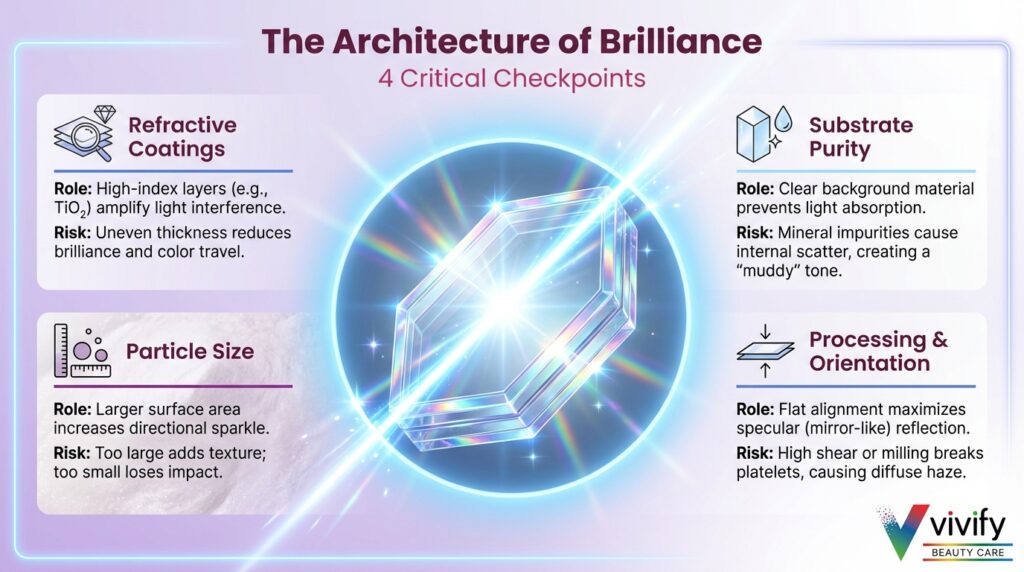
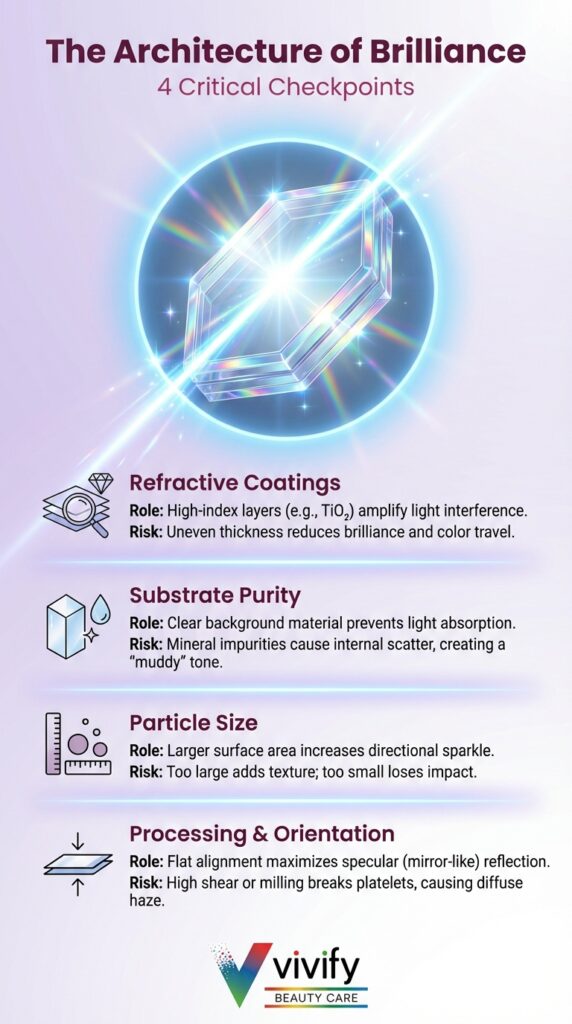
- Substrate Purity: The background material (often mica) can contain mineral impurities that increase unwanted light scatter or absorption, thereby reducing brightness.5 Additional insight on how engineered substrates function can be found within Vivify’s pearl effect pigments resources.
- Particle Size: Larger particles typically reflect more light and increase directional sparkle, though they may also introduce a slightly textured feel. Particle size distribution plays a central role in balancing sheen, smoothness, and optical output.2,4 A thorough particle size analysis can help you balance sheen and texture.
- Coatings: Uniform coating layers (for instance, with titanium dioxide) maximize surface reflectivity due to TiO₂’s high refractive index (~2.5–2.7), which enhances interference color and brightness.1 Find out how high reflector coatings can influence the clarity and brilliance of effect pigments within Vivify’s pigment technologies.
- Processing Conditions: Milling, dispersing, or pressing steps may alter particle orientation and lead to diminished brightness. Platelet breakage or misalignment increases diffuse reflection and reduces specular light return.3 Adjusting these conditions can be just as critical as ingredient selection when fine-tuning luminous effects.
When Natural Mica May Limit Performance
Natural mica has long served as a popular choice in cosmetics, prized for delivering gentle shimmer in products such as foundations, bronzers, and eyeshadows. It excels in everyday beauty applications where a soft, tasteful glow is desired. However, certain performance requirements can push natural mica to its limits. As a mined mineral, natural mica can exhibit variability in composition and morphology depending on geological origin.5
Strengths and Typical Uses for Natural Mica
Natural mica is well-suited to:
- Daily-Wear Products: Imparting an understated, elegant glow for complexion applications.
- Subtle Layers: Providing gentle highlights in eye shadows and lip products without overwhelming shine.
In modern product development, though, many formulators seek eye-catching brightness or metallic finishes. In these instances, natural mica may yield less reflectivity or saturation than desired, particularly in dramatic highlighters and bold color cosmetics designed for strong visual impact.1,2
Signs You May Be Approaching Natural Mica’s Limit
- Batch-to-Batch Variability: Even carefully managed processing conditions can’t always offset the inherent variability of mined mica, potentially leading to inconsistent performance.5
- Muted or Flat Appearance: If you’ve tweaked processing parameters without achieving the radiance you need, the shortfall may come from the substrate’s natural optical properties.1
- Excessive Pigment Loading: Piling more mica into the formula can produce weighty or cakey textures, often with limited gains in brightness. Exceeding optimal pigment volume concentration can reduce film uniformity and increase diffuse scatter rather than enhancing reflectance.4
Considering Synthetic Mica for Enhanced Performance
Synthetic mica—sometimes listed as synthetic fluorphlogopite—is laboratory-crafted under controlled conditions6. In certain high-performance contexts, it can address challenges that natural mica cannot. By managing purity, structure, and coating application, synthetic mica may offer more reliable brightness and glare potential, especially where a rich, bold payoff is desired.
Fundamental Attributes of Synthetic Mica
- Controlled Transparency and Purity: With fewer naturally occurring impurities, synthetic micas often offer a cleaner, more uniform read in reflective applications.6
- Tightly Monitored Particle Size Distribution: Manufacturing controls yield consistency from batch to batch, aiding in reproducible brightness and sparkle across production runs.2,6
- Tailored Coatings: Synthetic mica can be coated to produce a variety of reflective intensities—ranging from a subdued luminous finish to highly reflective, metallic effects—depending on product requirements.1,2
Examples of Practical Uses
- Highlighters: Where you want concentrated luminosity, the lab-controlled reflectivity of synthetic mica helps achieve eye-catching radiance.2
- Strobing Products: For makeup techniques that emphasize facial high points, synthetic mica’s clarity and consistent shine can help prominent features appear more pronounced.3
- Metallic Eyeshadows: Eye-catching, metallic finishes often require tighter particle-size control and specialized coating layers, which synthetic mica can deliver.1
Structured Framework: Should You Upgrade to Synthetic Mica?
Upgrading to synthetic mica is a strategic decision that hinges on performance needs, budget constraints, and the creative vision for your brand’s product lines. Below is a simple framework to guide your choice:
- Diagnose the Brightness Problem: Determine if your brightness shortfall is truly caused by mica limitations or by factors like binders or milling conditions. Confirm that adjustments to processing, pigment volume, or binder systems aren’t sufficient on their own.
- Set Clear Visual and Performance Goals: If your goal is subdued everyday radiance, natural mica may work well. If you want to deliver vibrant strobing effects or striking metallic finishes, synthetic mica might present a beneficial alternative without labeling it inherently superior.
- Plan Your Approach:
- Hybrid Blends: Consider blending natural and synthetic mica to moderate costs and create a balanced effect.
- Selective Use: Substitute synthetic mica in only your statement products—like highlighters, metallic eyeshadows, and brand-defining color lines—while retaining natural mica in your everyday formulas.
- Complete Integration: Brands that consistently push the envelope with bold color cosmetics can benefit from a full transition, though you’ll want to run comprehensive trials to optimize new formulations.
Extra Considerations When Using Synthetic Mica
Once you decide to explore synthetic mica, factor in any formulation shifts and testing protocols:
Measuring Brightness Effectively
Measuring brightness is more nuanced than visually checking a swatch. Many teams rely on tools like spectrophotometers or gloss meters to quantify reflectance and colorimetric values7. By regularly testing your product’s reflectivity, you can chart how adjustments in particle size or binder content impact brightness over multiple production runs.
Evaluating Formula Costs and Complexity
- Cost Factors: Synthetic mica can sometimes be more expensive than its naturally mined counterpart. When balancing overall performance with budget considerations, evaluate how frequently you need extreme shine or metallic finishes versus everyday radiance.
- Compatibility: Ensure binders, solvents, and other actives don’t interfere with how synthetic mica particles lay on the skin or in the formula matrix. Proper wetting and dispersion reduce agglomeration and haze that can diminish optical clarity.3
- Production Scalability: Confirm that your manufacturing processes—especially mixing, pressing, or extrusion—are adaptable to incorporate new materials.
Common Testing Stages
- Laboratory Trials: Confirm stability, color consistency, and visual performance with a small batch.
- Pilot Production: Scale up for short production runs to evaluate how the formulas behave in near-commercial conditions. Even minor changes—like altering press tonnage—can help synthetic mica distribute evenly in pressed products by influencing platelet alignment.3
- Consumer or Panel Testing: Gather user feedback to ensure the final result meets aesthetic and performance expectations.
Practical Substitution Tips
When substituting synthetic mica for natural mica or creating blends, consider these steps:
- Match Particles First: Aim for a consistent particle size distribution so your texture and payoff remain predictable.2
- Adjust Binders or Pressing Parameters: If synthetic mica’s particles align differently in a pressed powder, you may need to alter binding percentage or pressing force to optimize platelet orientation and brightness.3
- Monitor Long-Term Stability: Confirm that your final formula resists environmental factors like humidity or temperature changes.
FAQ: Synthetic Mica, Natural Mica & Cosmetic Brightness
What is synthetic mica (synthetic fluorphlogopite)?
Synthetic mica is a lab-manufactured mica substrate commonly listed on labels as Synthetic Fluorphlogopite. Because it’s produced under controlled conditions, it can offer more consistent purity, particle characteristics, and coating performance than mined mica in certain applications.6
Is synthetic mica the same as natural mica?
No. Natural mica is mined, while synthetic mica is manufactured. They can look similar in a finished product, but synthetic mica often provides more predictable performance when you need consistent brightness, clarity, or batch-to-batch repeatability.5,6
Why does my mica-based product look dull or “flat” on skin?
A muted payoff is often caused by increased diffuse light scatter and poor particle alignment rather than “bad mica”.1–3 Common contributors include:
- Poor dispersion or wet-out (agglomerates create haze)
- Particle size distribution that doesn’t match your target finish
- Coating quality/coverage (e.g., reflectors like TiO₂ not optimized)1
- Pressing/milling/processing that disrupts particle orientation3
- Overloading effect pigment, which can increase texture or muddiness4
What’s the difference between brightness, opacity, and sparkle?
- Brightness: overall light reflectance/luminance (how “lit” the product looks)1
- Opacity: coverage/hiding power (how much the base is concealed)4
- Sparkle: distinct points of light (often driven by particle geometry/size and surface texture)2
A formula can be sparkly without being bright, or opaque without looking radiant.
Why can synthetic mica look brighter than natural mica?
Synthetic mica can appear brighter because its controlled manufacturing often results in higher purity, more uniform particle characteristics, and more consistent coating application, which together reduce unwanted scatter and enhance reflectance.1,2,6 The result is often a clearer, more repeatable shimmer—especially in metallic or high-shine looks.
Will switching to synthetic mica automatically fix dull payoff?
Not always. If dullness is caused by binder choice, dispersion, filler balance, or pressing parameters, changing mica alone may only partially help.3,4
What’s the INCI name I should look for if I’m sourcing synthetic mica?
The most common INCI you’ll see is Synthetic Fluorphlogopite (often paired with coating materials depending on the effect pigment).
Advancing with Synthetic Mica for Optimal Luminance

By diagnosing brightness challenges thoroughly, aligning your product goals, and testing carefully, you can optimize your approach to mica selection without promoting one substrate as inherently better than another. In many high-demand applications—like edgy metallic eyeshadows, highlighters, or special-event cosmetics—synthetic mica’s controlled production process can offer a strong, reliable option for enhanced reflectivity and consistent sparkle.
If you’re exploring ways to refine your existing product line or looking to develop truly standout offerings, synthetic mica may open the door to new visual possibilities. The key is integrating it thoughtfully, running proper tests, and ensuring it meets your market ambitions.
To dive into more formulation solutions, explore additional effect pigments, or request a sample, contact Vivify Beauty Care.
References
- Pfaff, G. (2008). Pearlescent pigments based on mica substrates. Journal of Minerals & Materials Characterization & Engineering, 7(4), 287–305. https://doi.org/10.4236/jmmce.2008.74021
- Buxbaum, G., & Pfaff, G. (2005). Industrial inorganic pigments (3rd ed.). Wiley-VCH. https://onlinelibrary.wiley.com/doi/book/10.1002/3527603978
- Hollenberg, G. W., & Halloran, J. W. (1979). Particle orientation in tape casting. Journal of Materials Science, 14, 1933–1942. https://doi.org/10.1007/BF00551045
- Bohren, C. F., & Huffman, D. R. (1983). Absorption and scattering of light by small particles. Wiley. https://onlinelibrary.wiley.com/doi/book/10.1002/9783527618156
- Deer, W. A., Howie, R. A., & Zussman, J. (2013). An introduction to the rock-forming minerals (3rd ed.). Mineralogical Society. https://doi.org/10.1180/minmag.2013.077.3.18
- Guggenheim, S., & Martin, R. T. (1995). Definition of clay and clay mineral. Clays and Clay Minerals, 43(2), 255–256. https://doi.org/10.1346/CCMN.1995.0430213
- Berns, R. S. (2000). Billmeyer and Saltzman’s principles of color technology (3rd ed.). Wiley. https://onlinelibrary.wiley.com/doi/book/10.1002/0471693620