Key Takeaways
- Natural Mica in Cosmetics: Sought after for its radiant shimmer and versatile aesthetic appeal in various cosmetics.
- Geological Origin: Derived primarily from granite and pegmatite deposits in India and Madagascar, with muscovite and phlogopite variations.
- Potential Ethical Sourcing Challenges: Includes child labor and unsafe conditions in unregulated mining, and opaque supply chains impacting transparency.
- Technical Differences: Compared to other effect pigment bases, natural mica offers a unique natural shimmer and variability but can lack the range of color travel available with other bases.
- Safety and Compliance: Requires stringent testing to ensure compliance with regulatory standards for contaminants like heavy metals.
- Formulation Best Practices: Optimize product performance with mica through appropriate particle size, pre-mixing, and suspending agents.
- Emerging Trends: Advancements in ethical mining and the development of alternative pigments, including synthetic and lab-grown mica.
- Consumer Transparency: Encourage transparent labeling and communication to foster trust
- Ongoing Research: Prioritize blockchain verification and collaborative initiatives to improve transparency and ethical sourcing in the supply chain.
Natural mica has long been a key ingredient in cosmetics, celebrated for creating radiant shimmer and luminous effects. This article provides a technical yet approachable exploration of natural mica’s properties, practical applications, ethical considerations, and formulation best practices, offering actionable insights for formulators, R&D teams, and consultants.
What Is Natural Mica? (Mineral Origins and Properties)
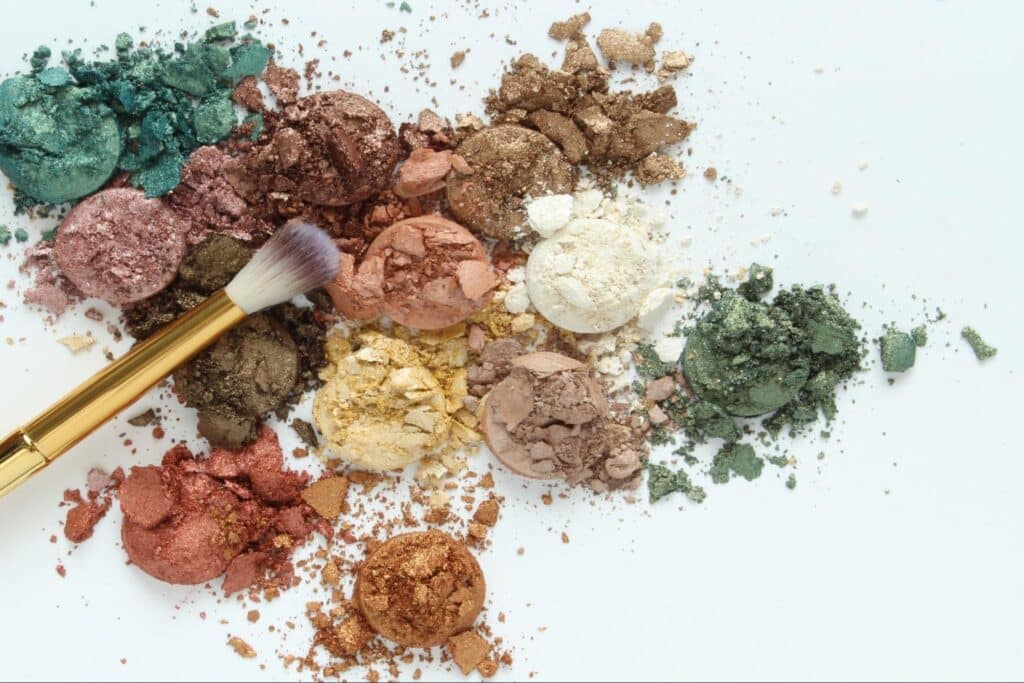
Natural mica is a mineral valued for its layered structure, which allows it to be separated into thin sheets and processed into a fine powder or flake (see Hayatullah et al., 2025). It is primarily mined from granite and pegmatite deposits, with significant reserves found in India and Madagascar. Variants such as muscovite and phlogopite (a mica that exhibits a slightly brownish tone) provide subtle differences in color and composition, lending unique aesthetic qualities to cosmetic formulations.
Geological Origins and Composition
Mica is extracted from regions abundant in pegmatite deposits. Muscovite is typically clear or pale, whereas phlogopite offers warmer, golden hues. Its distinctive sheet-like structure allows for a range of particle sizes, which directly affects the shimmer and reflective qualities that make mica highly desirable in cosmetics.
Key Pigment Properties
- Transparency and Radiance: Enhances formulations with a translucent shimmer or pearlescent effect.
- Particle Versatility: Can be milled into various sizes from bold glitter to a delicate glow.
- Stability: Exhibits chemical and thermal stability, ensuring consistent performance in diverse applications.
Applications: How Natural Mica Is Used in Cosmetics
Natural mica improves cosmetic formulations by diffusing light and enhancing texture. It plays a vital role in numerous products, elevating both visual appeal and sensory performance.
Key Product Categories
- Eyeshadows and Highlighters: Imparts vibrant shimmer and accentuates facial features.
- Lip Products: Adds a subtle sheen or metallic finish that complements colorants.
- Face Powders and Foundations: Scatters light to achieve a soft-focus effect that minimizes imperfections.
- Nail Polishes: Enables a variety of finishes, from satin to bold glitter effects.
Building on these applications, the following section compares natural mica with synthetic alternatives, addressing both technical performance and ethical implications.
Natural vs. Synthetic Mica: Technical Comparison
Choosing between natural and synthetic mica involves weighing technical performance, sensory attributes, and portfolio goals for your specific product.
Optical Performance and Color Range
- Natural mica: Provides a soft, “earthy” shimmer with subtle variations from batch to batch. This can add visual depth and a more natural-looking glow to complexion and eye products.
- Synthetic mica: Engineered on a controlled substrate to deliver very bright, clean, and uniform color effects, including intense pearlescence and stronger color travel when combined with certain metal oxides.
Purity and Consistency
- Natural mica: As a mined mineral, it can contain trace impurities and demands rigorous purification and testing (e.g., for heavy metals) to meet cosmetic-grade standards. Natural variability can influence shade and reflectivity between batches.
- Synthetic mica: Manufactured under controlled conditions, which typically allows for tighter control over purity, particle shape, and batch-to-batch consistency.
Particle Size, Feel, and Application
- Natural mica: Available in a wide particle size range—from ultrafine for soft-focus effects in face powders to larger flakes for body and eye shimmer. It tends to feel smooth on the skin when well-milled, but very large particles can be more perceptible on application.
- Synthetic mica: Often offers very precise particle size distributions, supporting ultra-silky textures and highly uniform payoff, which can be advantageous in pressed powders, highlighters, and advanced effect pigments.
Formulation and Performance Considerations
- Natural mica works well when a subtle, natural-looking radiance and mineral positioning are key.
- Synthetic mica is often selected when a stronger, more dramatic effect or highly standardized appearance is required across global markets.
In practice, many brands use a blend of natural mica and synthetic alternatives to balance aesthetics, performance targets, and product positioning.
Is Natural Mica Safe and Truly “Natural”?
While natural mica is generally safe for cosmetic use, its “natural” label entails certain nuances due to the substantial processing it undergoes.
Regulatory Compliance and Testing
Cosmetic-grade mica must comply with strict regulatory limits for contaminants such as lead, arsenic, mercury, and cadmium. Reputable suppliers perform comprehensive testing to ensure purity. Collaborations with organizations like the Responsible Mica Initiative encourage ongoing improvements in safety standards.
Defining “Natural”
The term “natural mica” implies its mineral origin. However, to meet performance standards, the raw material undergoes cleaning, purification, and sometimes coating (e.g., with silicone). As a result, the final ingredient is a blend of raw and refined elements.
Addressing Skin Sensitivities
Natural mica is largely non-irritating and suitable for most skin types. Formulators should source mica that has undergone rigorous contaminant testing, especially when designing products for sensitive skin.
Regulatory Watchpoint
Staying current with evolving FDA and EU cosmetic safety regulations is essential, and ongoing quality testing helps ensure consumer safety. Additionally, the European Commission often updates its mandates on allowable trace levels of heavy metals in color additives, and these changes can directly impact the permissible usage of mica in formulations.
Keeping abreast of these developments through trade associations and official regulatory gazettes ensures that product lines remain compliant and safe for consumers.
Sourcing Challenges and Solutions
When working with natural mica in cosmetics, sourcing realities can be as complex as the technical requirements of a formula.
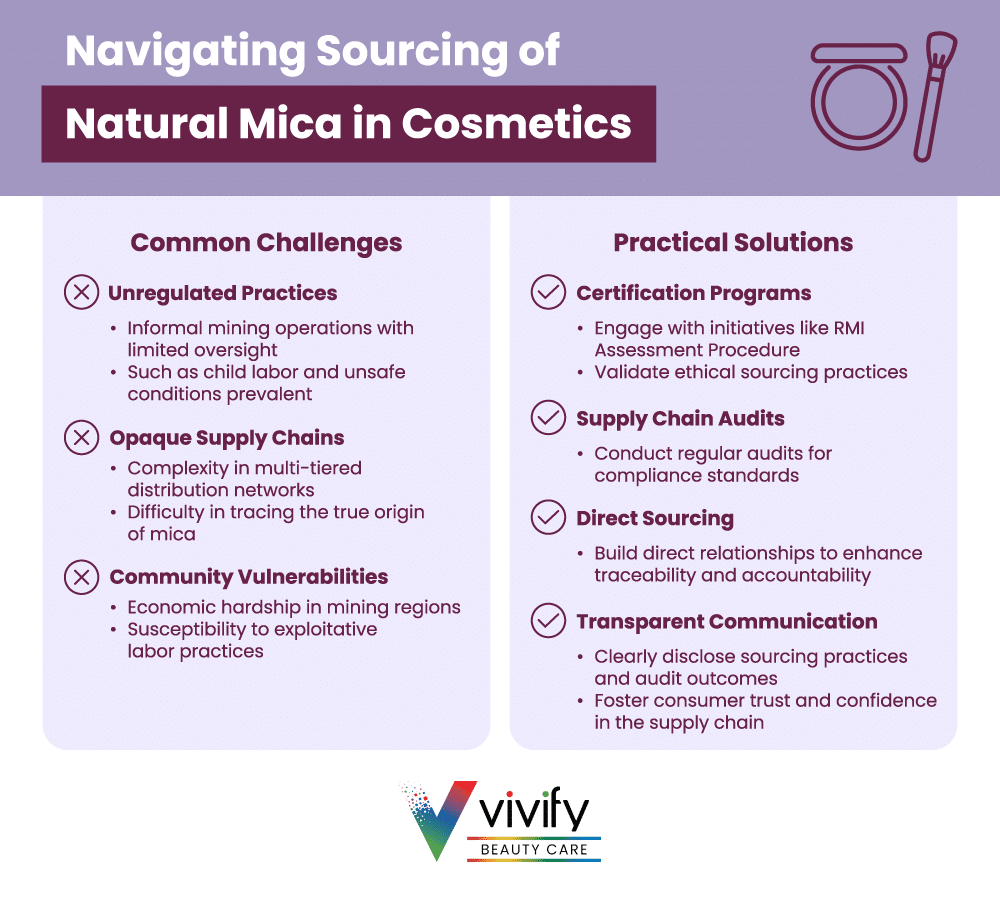
Responsible sourcing of natural mica confronts challenges such as unregulated mining, opaque supply chains, and community vulnerabilities.
Common Challenges
- Unregulated Practices: Informal mining operations may lack oversight, leading to issues like child labor and unsafe work conditions.
- Opaque Supply Chains: Complex, multi-tiered distribution networks can obscure the true origin of mica.
- Community Vulnerabilities: Economic hardship in mining regions may foster exploitative labor practices, including instances of child labor in certain mining sectors.
Practical Solutions
- Certification Programs: Engage with initiatives like the RMI Assessment Procedure for Mica Processors to validate ethical sourcing.
- Supply Chain Audits: Regular audits help confirm that suppliers adhere to fair labor and environmental standards.
- Direct Sourcing: Building direct relationships with suppliers enhances both traceability and accountability.
- Transparent Communication: Clearly disclose sourcing practices and audit outcomes to build consumer trust.
In some related sectors, innovative practices such as mechanized extraction and strengthened community programs have been employed to reduce hazards. At the same time, real-world impacts vary, and continuous vigilance through initiatives like those conducted by child rights organizations remains crucial.
Best Practices for Formulating with Natural Mica
Optimizing product performance with natural mica requires careful attention to dispersion, stability, and ingredient compatibility.
Enhancing Blendability
- Appropriate Particle Size: Use ultrafine mica for face powders and larger flakes for body glitters.
- Pre-Mixing: Incorporate mica during the oil phase or with a dispersant to prevent clumping.
- Moderate Mixing: Avoid excessively vigorous mixing that might damage delicate mica flakes.
Mitigating Settling
- Suspending Agents: Ingredients such as xanthan gum or carbomer maintain an even dispersion.
- Viscosity Adjustment: Higher yield formulations are more effective at keeping mica suspended throughout the product.
Compatibility and Binder Selection
- Maintain pH Balance: Ensure the formulation’s pH supports both mica stability and the activity of other ingredients.
- Binder Optimization: In pressed powders, minimal binder use preserves mica’s natural shimmer while ensuring product integrity.
Formulator’s Tip: Experiment with different ratios of binders and fillers to achieve optimal dispersion and preserve mica’s luminous finish within your formulations. Furthermore, running small pilot batches under varying temperature and humidity conditions provides deeper insights into how mica interacts with other ingredients. Testing different mixing speeds, pre-blends, and the order of ingredient addition also helps maintain mica’s reflective properties. Always keep a record of these parameters to replicate successful formulations and maintain consistent quality across multiple production runs.
Emerging Trends and Innovations in Mica Sourcing and Alternatives
Sustainability is driving innovations in both traditional mica sourcing and the development of alternatives.
Advancements in Ethical Mining
Innovative extraction methods and community engagement programs have been piloted to improve working conditions for miners.
Alternative Pigments
- Synthetic Mica: Delivers consistent performance. Although its production generally involves higher energy expenditure, it may mitigate some of the labor concerns associated with natural mining.
- Lab-Grown and Recycled Pigments: Emerging alternatives that reduce environmental impact and expand formulation possibilities.
Future Outlook
A heightened focus on sustainability and performance continues to shape the cosmetics industry. Emerging materials, including bio-based pigments, promise to minimize environmental impacts while meeting rigorous performance standards.
Strategies for Overcoming Mica Supply Chain Complexities
Overcoming the complexities within the mica supply chain is crucial for product excellence.
The fragmented nature of mica mining, compounded by multiple intermediaries, can obscure the raw material’s origin. To address this, brands should build long-term partnerships with suppliers dedicated to ethical practices. This involves rigorous background checks, supply chain audits, and implementing digital traceability, sometimes leveraging trade data or blockchain-based solutions for real-time monitoring.
Collaborating with local NGOs and groups can yield independent perspectives on labor practices and environmental compliance. Moreover, investing in R&D, exploring alternative pigments or mechanical processing upgrades, can strengthen supply chain resilience.
Consumer Concerns and Labeling: Communicating Transparency
As consumers increasingly scrutinize cosmetic ingredient sourcing, transparent communication is paramount to building trust.
Tackling Common Safety Questions
- Safety Reassurance: Highlight that purified natural mica is safe for cosmetic use, supported by heavy metal testing and guidelines from credible mineral education resources.
- Sensitive Skin Considerations: Clearly communicate the measures taken to ensure high purity, especially in products designed for sensitive skin.
Navigating Labeling Challenges
- Avoid Overgeneralization: Replace vague claims like “100% ethical” with specific information on supplier certifications and audit results.
- Transparent Education: Use clear, factual language to explain the sourcing and processing journey of mica, avoiding overstated claims.
Ongoing Research and Collaborative Efforts
Continuous research and industry collaboration are vital to improving both processing methods and ethical sourcing practices. Many leading cosmetic companies partner with academic institutions and independent laboratories to refine testing techniques and ensure compliance with the latest safety standards. Collaborative projects with local communities and NGOs further promote sustainable practices that enhance working conditions and help ensure fair economic returns for miners.
Future Research Directions
Several pilot initiatives are currently exploring blockchain-based verification to heighten transparency, as outlined in the Responsible Mica Initiative’s approach to improving supply chain accountability. Such innovations are expected to improve consumer confidence and traceability in natural mica sourcing.
Natural Mica: Clean Beauty, Alternatives, and Transparency
Natural mica remains a cornerstone ingredient in cosmetics, prized for its transformative shimmer, versatility, and skin-friendly properties. Its significance goes beyond aesthetics, reflecting the industry’s commitment to safety, ethical sourcing, and regulatory compliance.
For formulators and industry experts, these insights offer a clear roadmap for innovative, transparent, and sustainable product development. Reach out to the team at Vivify Beauty Care today to discover how your formulations can lead in ethical innovation and set new industry benchmarks.