

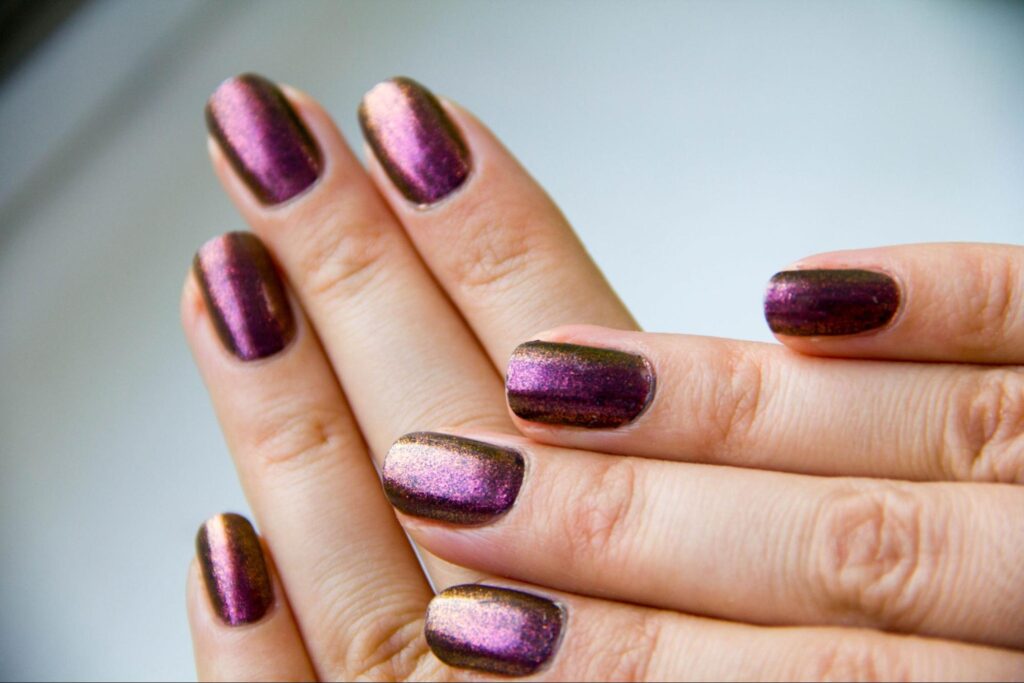
Color travel pigments offer one of the most technically demanding and commercially rewarding effects in cosmetic formulation. When executed well, they produce dramatic, angle-dependent color shifts that no conventional pigment can replicate. When executed poorly, the effect disappears into a muddy base or a washed-out tone that renders the intended shift invisible at any angle.
This guide is written for cosmetic chemists and product developers who need more than a category overview. It covers how thin-film interference governs the color travel effect, what substrate choices mean in practice, how to build a base color that supports rather than undermines the shift, and how to incorporate without destroying the optical structure that makes them work.
If you’re new to the distinction between effect pigments and conventional colorants, the foundational differences are covered in Effect Pigments vs. Traditional Pigments: Boost Beauty Impact. This blog picks up where that overview leaves off.
Key Takeaways
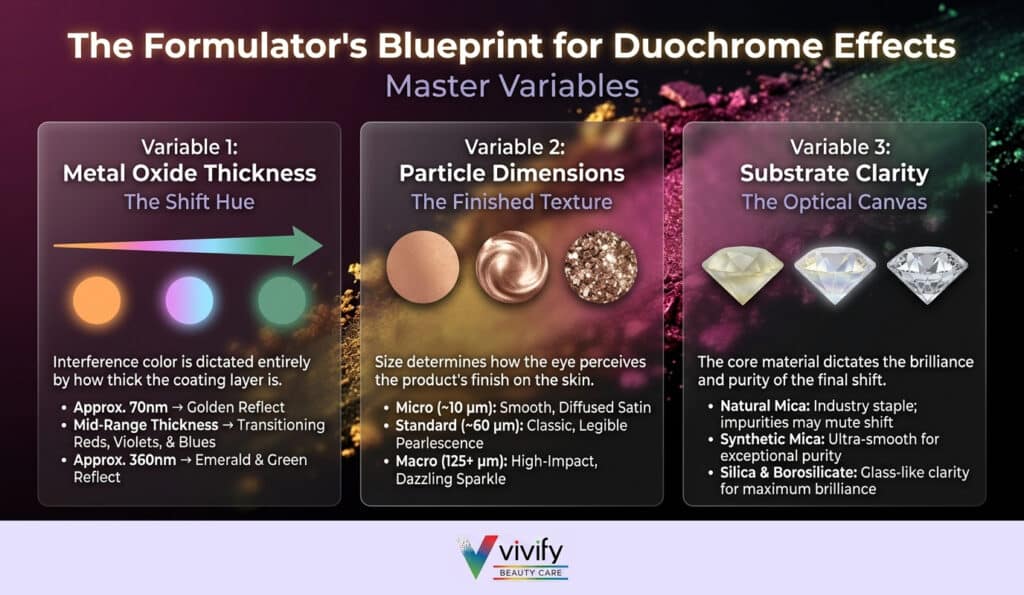
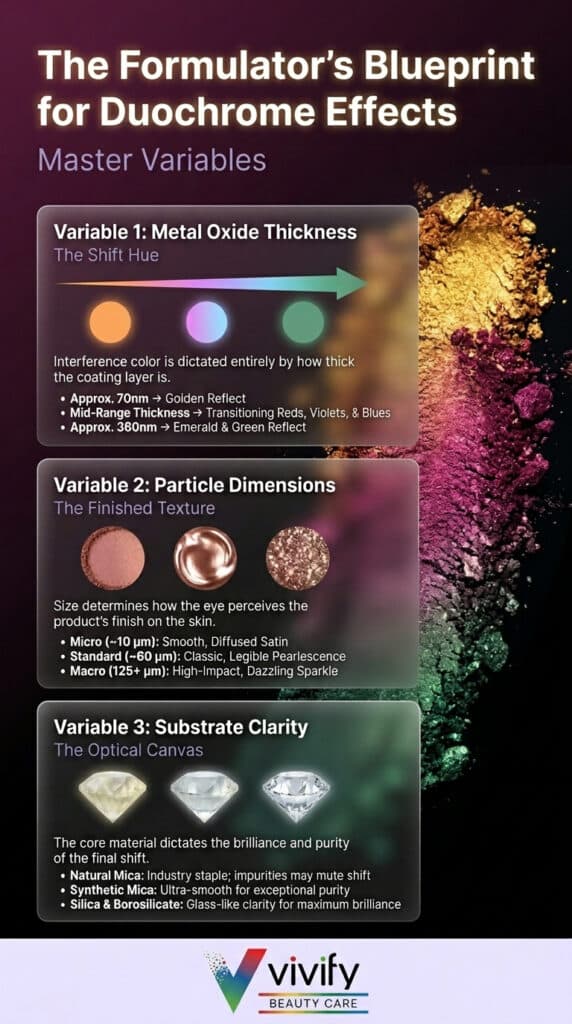
- Color travel pigments generate their effect through thin-film interference, not dye chemistry. Coating thickness — not pigment composition — determines which color is reflected. Coatings of approximately 70 nm produce gold; increasing thickness progresses through red, violet, and blue to approximately 360 nm for green.
- Substrate choice directly affects brilliance and color purity. Silica and alumina flakes offer smoother surfaces and greater optical clarity than natural mica. Natural mica’s surface roughness and trace iron oxide content can reduce brilliance and introduce an unintended mass tone.
- Particle size governs finish type. Approximately 10 µm produces a satin effect, 60 µm yields a pearlescent finish, and particles ≥125 µm deliver sparkle. Matching particle size to the application format is a deliberate formulation decision.
- Base color is the foundation of a successful duochrome formulation. Adding a TiO2-coated interference pigment to a light, low-opacity base can eliminate the base color entirely — producing a white appearance rather than the intended shift. This is a common and avoidable error.
- High-shear mixing degrades or eliminates the color travel effect. The metal oxide coating layers responsible for interference are mechanically fragile. Color travel pigments should be added at the lowest feasible shear stage and pre-dispersed before incorporation into the main batch.
The Science Behind Color Travel: How Thin-Film Interference Generates Color Shift
Color travel pigments generate their effect through thin-film interference — a physical mechanism that operates differently from every other colorant category. Understanding it is what allows formulators to make deliberate decisions about substrate, coating, and processing, rather than managing the effect by trial and error.
How Interference Creates Angle-Dependent Color
Color travel pigments — also called duochrome or optical variable pigments — produce their visual effect through thin-film interference. When light strikes the metal oxide coating on a substrate platelet, some is reflected at the outer surface and some passes through to reflect at the substrate surface below. These two reflected waves interfere with each other: constructively at certain wavelengths (producing a visible color) and destructively at others (suppressing complementary colors).
Because the interference geometry changes as the viewing angle changes, the reflected color shifts across the spectrum. The color is structural — generated by physics, not pigment chemistry. No dye or conventional absorption pigment can replicate the mechanism.
Coating Thickness Determines the Shift Pair
The specific wavelength reinforced by interference depends on the optical thickness of the metal oxide coating. Industry characterization data shows the following progression:
- ~70 nm: Gold
- Increasing thickness: Progresses through red → violet → blue
- ~360 nm: Green
This coating-to-color relationship allows pigment manufacturers to engineer specific shift pairs: gold-to-red, blue-to-violet, green-to-copper. The shift pair is fixed at the manufacturing stage. The formulator’s job is to build a system that allows the intended effect to express fully in the finished product.
Platelet Orientation Determines Shift Intensity
Maximum color travel and optical sharpness are achieved when substrate platelets are uniformly oriented parallel to the surface. Any disruption to that alignment — turbulence during processing, high-viscosity matrices that trap particles at random angles, or surface roughness on the substrate itself — reduces both the intensity and perceived clarity of the shift.
This is why substrate selection and processing protocol are not secondary considerations — they directly control whether the interference effect performs as intended.
Substrate Selection: Mica, Silica, Alumina, and Borosilicate
The substrate is the structural foundation of any color travel pigment. It must be optically transparent, dimensionally stable, and smooth enough to support a uniform metal oxide coating — and those requirements vary meaningfully across substrate types, with direct consequences for optical performance.
The following table summarizes the key trade-offs for the most common substrates, based on NYSCC special effect pigment data and CTPA substrate characterization guidance:
| Substrate | Surface Quality | Optical Properties | Key Formulation Considerations |
| Natural mica (muscovite) | Moderate | Reduced clarity from trace impurities | Trace impurities can introduce an unintended mass tone; rougher surface increases light scattering, reducing brilliance |
| Synthetic mica (fluorophlogopite) | High | Excellent transparency | Smoother surface enables more precise interference coatings; preferred when color purity is critical |
| Silica flakes | Very high | High brilliance | Greater smoothness vs. natural mica; excellent optical clarity; lower refractive index than mica |
| Alumina flakes | High | Distinctive refractive behavior | Different refractive index profile produces unique shift characteristics compared to mica-based substrates |
| Borosilicate | Very high | Glass-like transparency | Produces a luminous, high-transparency finish; suitable for applications requiring maximum clarity in the interference effect |
Natural mica has been the industry standard since TiO2-coated muscovite mica entered commercial cosmetic use in the 1970s. Its limitations, however, are real. Trace impurities in the crystal structure can introduce an unintended mass tone that competes with the intended shift color, while its rougher surface causes more light scattering and reduces the optical sharpness of the interference effect. For applications where shift brilliance and color purity are primary requirements, synthetic mica, silica, and alumina substrates typically perform better — at a higher raw material cost.
Substrate selection also intersects with supply chain and compliance considerations. Vivify Beauty Care is a Responsible Mica Initiative member, providing access to responsibly sourced mica options for brands with supply chain accountability requirements. Both natural and synthetic mica options are available across Vivify’s effect pigments and colors portfolio, including substrate-specific color travel grades.
Particle Size and Finish: Matching the Effect to Your Application Format
Particle size controls the visual character of the finished effect independently of the color shift. Smaller particles produce softer, more diffuse finishes; larger particles create more intense, sparkle-rich effects. The following correlations hold broadly across substrate types:
- ~10 µm: Produces a satin finish — soft, directional color travel with subtle shift expression. Well-suited to skin-close formulations where a smooth, blended appearance is preferred over a declared optical effect.
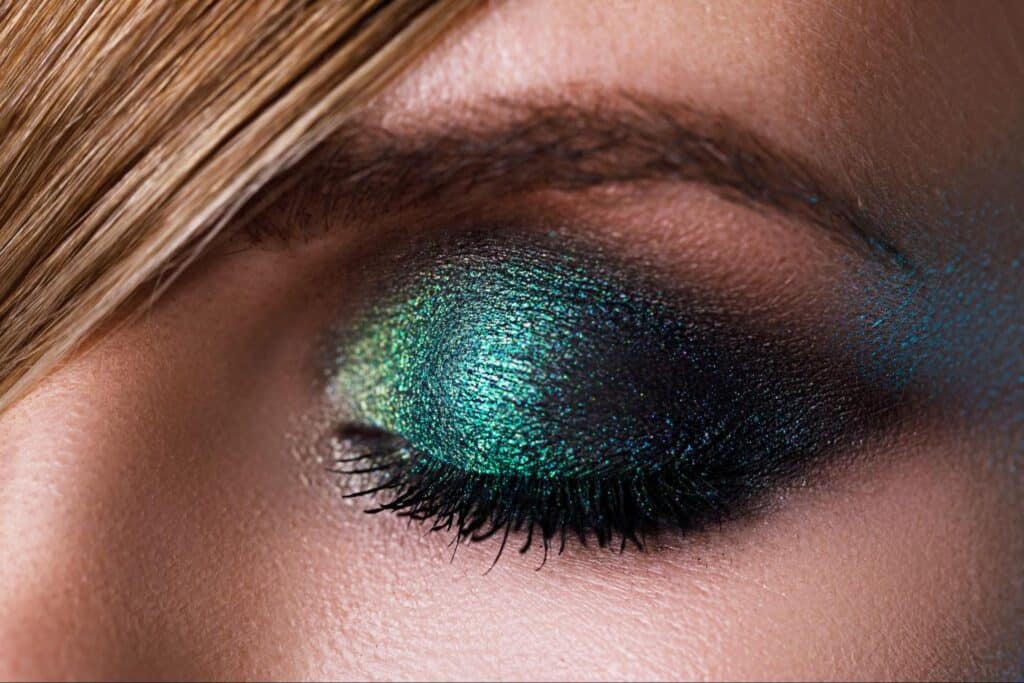
- ~60 µm: Delivers a dazzling pearlescent finish with clear, legible color travel. This is the most widely used particle size range for eyeshadows, highlighters, and color cosmetics where shift is the intended visual signature.
- ≥125 µm: Produces visible sparkle with high optical impact. Best suited for pressed highlighters designed for buildable intensity, loose powder formats, and top-coat applications where particle migration is less of a concern.
Particle size also interacts with the final film thickness of the formulation. In thin-film applications — lip glosses, liquid foundations, sheer primers — large-particle pigments may not orient fully within the film depth, limiting shift expression. For these formats, mid-range particle sizes often produce more consistent and visible color travel than maximally-sized sparkle grades.
Building the Base Color: The Most Underestimated Variable in Duochrome Formulation
Color travel pigments do not replace a base color — they modify the appearance of one. The base color is what the eye perceives at angles where interference is weakest, and it establishes the contrast against which the shift color is read. When the base is absent, too light, or overpowered by the pigment’s own opacity, the shift behavior changes — often dramatically.
A well-documented illustration: adding a TiO2-coated interference pigment to a light pink lipstick without sufficient base opacity can produce an entirely white appearance. The TiO2 coating’s reflectivity overwhelms the light base, erasing both the base color and the intended interference shift. This example — documented in HunterLab’s work on duochrome cosmetic development — illustrates a failure mode that is common, reproducible, and preventable with a deliberate base color strategy.
The key formulation principles for base color selection:
- Build adequate base opacity before adding the color travel pigment. The base should establish the off-angle color — what the formulation reads at low-interference viewing angles.
- Choose base colors that contrast with the interference reflection. High-contrast base-to-shift pairs produce the most commercially legible duochrome effect. A deep burgundy base with a gold shift is more dramatically readable than a pale pink base with a subtle peach shift.
- Account for the pigment’s mass tone. Color travel pigments often have a visible mass tone — typically complementary to the primary interference hue — that contributes to the perceived base at normal viewing angles. This must be factored into the base formulation, not treated as a finishing variable.
For complex duochrome formulations, spectrophotometric measurement at multiple angles is the most reliable method for confirming the intended shift is expressing as designed and the base is providing adequate opacity and contrast.
Incorporating Color Travel Pigments Without Degrading the Effect
The physical structure responsible for color travel — uniformly deposited metal oxide layers on a flat substrate platelet — is mechanically fragile relative to conventional pigments. Processing choices that are inconsequential with iron oxide or organic pigments can substantially degrade or eliminate the interference effect.
Critical incorporation rules for color travel pigments:
- Avoid high-shear mixing after pigment addition. High shear can fracture or displace the metal oxide coating layers, directly reducing interference performance. Color travel pigments should be added at the lowest feasible shear stage in the manufacturing sequence.
- Pre-disperse before adding to the bulk. Pre-dispersion in a small quantity of compatible oil, ester, or humectant distributes the pigment uniformly before it contacts the full batch, reducing shear demand at the main incorporation stage.
- Use surface-treated grades where available. Surface treatments improve dispersion, enhance stability, and can allow the pigment to be contained in a preferred phase of an emulsion system. Surface treatments are a reliable lever for improving processability without sacrificing optical performance.
- Consider platelet orientation in the final film. In leave-on film products — pressed powders, lip products, cream highlighters — matrix viscosity at the point of film formation controls whether platelets align parallel to the surface. Higher-viscosity matrices during film formation can trap platelets at sub-optimal angles, reducing perceived shift in use.
Application-Specific Guidance
Incorporation strategy shifts meaningfully by product format:
- Pressed eyeshadow and highlighter: Typically the most forgiving format for color travel pigments. The pressing process promotes favorable platelet alignment. Use mid-range to larger particle sizes (60–125+ µm) for maximum visible shift. Binder selection can affect platelet orientation; test multiple binder systems before locking the formulation.
- Lip products (lipstick, gloss, balm): Melt processing requires careful management to avoid shear during cooling. Add the color travel pigment at the lowest feasible temperature after the wax/oil matrix is fully incorporated. Gloss formats allow larger particles to express well; lipstick matrices are thicker and may limit shift intensity — compensate through base contrast rather than increasing pigment load.
- Cream and liquid highlighter: Emulsion structure and final film thickness both affect shift expression. Pay close attention to film thickness in consumer use — a thin-film application may suppress the full shift arc. Phase-volume ratio and emulsifier selection influence how well platelets orient at the oil-water interface.
- Nail lacquer: Film formation during lacquer drying aligns platelets exceptionally well, making nail one of the strongest formats for vivid, high-contrast color travel. Film thickness consistency across coats is the primary variable affecting shift repeatability.
Regulatory Status of Color Travel Pigment Substrates
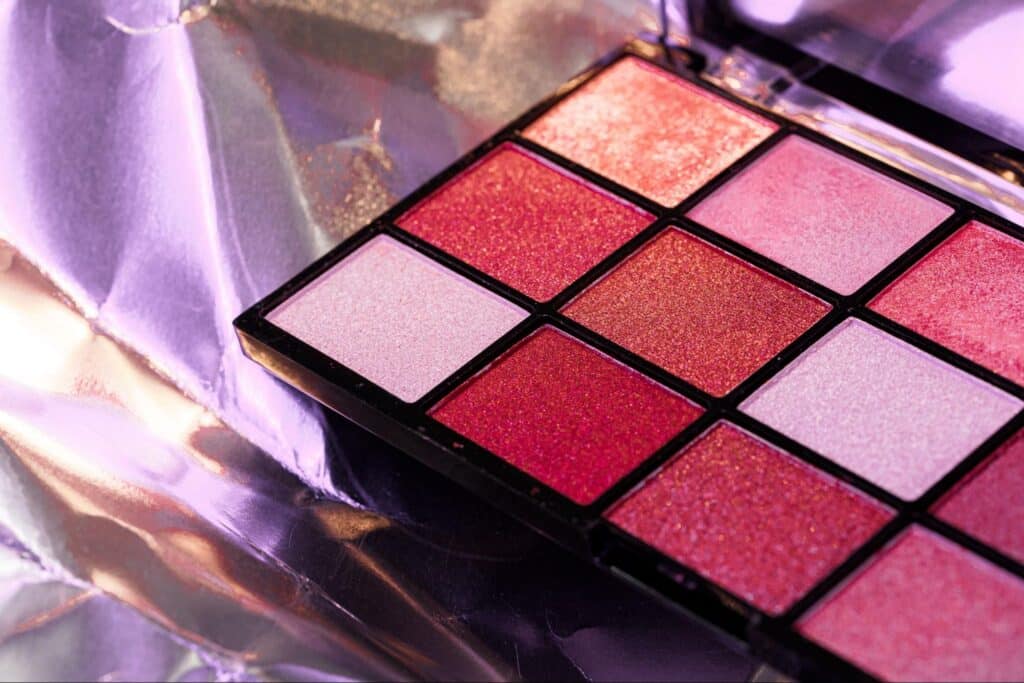
Color travel pigments used in cosmetics must comply with color additive regulations in each target market. Approval status varies by substrate, coating material, and application category — and the differences matter most for eye-area products, where the regulatory requirements are stricter and less uniformly familiar to formulators.
United States: FDA 21 CFR
The FDA’s color additive framework under 21 CFR governs which substrates and coatings are permitted and for which applications. Key considerations for color travel pigment formulations:
- Mica, titanium dioxide, and iron oxides are generally permitted for cosmetic use, but eye-area approval status varies by individual listing. Confirm each component is specifically approved for your intended application category before finalizing specs.
- Synthetic fluorophlogopite carries its own listing and approval status, separate from natural muscovite mica. Do not assume equivalency between the two for regulatory purposes.
- For eye-area products — eyeshadow, eyeliner, mascara — confirm regulatory documentation with your pigment supplier for every component: substrate, coating, and surface treatment.
European Union: Regulation (EC) No 1223/2009
EU approval status is governed by Regulation (EC) No 1223/2009 and Annex IV, the permitted colorants list. The framework is parallel to the U.S. structure but not identical — approved materials and application restrictions do not map one-for-one across markets.
- Verify each substrate and coating material against the relevant Annex IV entries for your intended application category before scale-up.
- When developing for dual US/EU market entry, confirm regulatory status independently in each market. Approval in one jurisdiction does not guarantee approval in the other.
Frequently Asked Questions About Color Travel Pigments
What is the difference between duochrome and multichrome pigments?
Duochrome pigments shift between two distinct colors at different viewing angles. Multichrome pigments — also called chameleon or color-flop pigments — shift through three or more colors across the viewing arc, achieved through more complex multi-layer coating structures. They follow the same substrate and incorporation principles as duochrome pigments, but tend to be more optically sensitive to processing conditions.
Can high-shear mixing be used if the color travel pigment is added slowly?
No. The issue is not the rate of addition but the shear energy environment the pigment is exposed to after addition. Even gradual introduction under high-shear conditions exposes the metal oxide coating layers to mechanical stress that can fracture them and degrade the interference effect. Color travel pigments should always be added after high-shear processing is complete, at the lowest-energy mixing stage available in the manufacturing sequence.
How does substrate choice affect compliance for eye-area products?
Substrate and coating material approvals vary by application category under FDA 21 CFR regulations and EU Annex IV. Natural mica, synthetic fluorophlogopite, titanium dioxide, and iron oxides each carry different listing statuses for eye vs. non-eye use. Before specifying a color travel pigment for an eye-area formulation, confirm with your pigment supplier that each component — substrate, coating, and any surface treatment — has the appropriate regulatory clearance for your target market and intended application.
What should I do if the color travel effect disappears in my finished formula?
Troubleshoot from the base up. First, confirm the base has sufficient opacity and contrast to support visible shift expression. Second, check whether high-shear processing occurred after pigment addition. Third, assess final film thickness in use — very thin films may not allow full platelet orientation. Finally, review particle size relative to your application format. Particle size mismatch is among the most common causes of flat results in thin-film leave-on products.
Are natural mica and synthetic mica interchangeable in color travel formulations?
They perform differently. Synthetic fluorophlogopite has a smoother, more consistent surface than muscovite mica, which reduces light scattering and improves interference color purity. For formulations where maximum brilliance or a precisely targeted shift color is required, synthetic mica typically outperforms natural mica. For applications where shift intensity is secondary to cost or supply chain positioning, responsibly sourced natural mica remains a practical option — particularly given that Vivify’s provides access to verified supply chains for both substrate types.
Partner with Vivify on Your Next Color Travel Formulation
Color travel pigments reward deliberate formulation choices across substrate, particle size, base color, and processing protocol — and they expose imprecise ones. The variables interact, which means access to a broad, well-characterized portfolio alongside hands-on technical support makes a meaningful difference at the bench.
Vivify Beauty Care offers one of the industry’s largest collections of effect pigments and colors, including color travel options across a range of substrates, particle sizes, and shift pairs. Our formulation and lab services — including shade matching, prototype development, and formulation troubleshooting — are available to support your next project.
Ready to evaluate color travel pigment options for a current formulation? Contact the Vivify team to request samples, explore substrate options for your application format, or connect with a technical specialist.