
Key Takeaways
- Choose architecture first, not a single emulsifier. The “right” emulsifier system depends on whether you need an O/W (Oil-in-Water), W/O (Water-in-Oil), or W/Si (Water-in-Silicone) structure to meet your texture, performance, and processing goals.
- Use the three pillars to guide selection: stability (separation/temperature/oxidation), sensorial experience (slip, cushion, afterfeel), and active delivery (compatibility, protection, release).
- O/W systems excel at lightweight feel but have predictable failure modes. They’re great for fast-absorbing products and water-soluble actives, but need strategies to manage creaming/coalescence, oxidation, and electrolyte/pH sensitivity.
- W/O systems are favored for water resistance and occlusivity, with strengths in robust barrier formation and supporting hydrophilic actives in the internal phase.
- W/Si systems (Water-in-Silicone) provide unique sensory profiles, enhanced water resistance, and can be tailored for specific aesthetics—making them valuable in modern suncare and color cosmetics.
- Lamellar emulsions offer exceptional stability and skin compatibility, especially for high-actives formulas, and are widely used in pharma and advanced skincare.
- Validation is non-negotiable. Stability and sensory testing (e.g., accelerated aging, centrifugation, freeze–thaw, rheology, panels) confirm that the chosen system will hold up from bench to shelf.
Oil and water don’t naturally stay mixed—yet modern skincare, suncare, and color cosmetics rely on emulsions to deliver elegant textures, reliable stability, and consistent performance.1,2 The challenge is that emulsifier selection is rarely just about picking a single ingredient; it’s about choosing the right emulsion architecture for your formula’s goals and constraints.
This guide takes an architecture-first approach to help you choose between Oil-in-Water (O/W), Water-in-Oil (W/O), and Water-in-Silicone (W/Si) systems. You’ll learn how each structure influences the three pillars of emulsion design—stability (resisting separation, temperature stress, and oxidation), sensorial experience (slip, cushion, afterfeel, and absorbency), and active delivery (compatibility, protection, and release).1,2,14 Along the way, we’ll cover common failure modes, practical formulation strategies, and the stability and sensory tests that confirm your chosen system will hold up from bench to shelf.1,12
We’ll also cover lamellar (liquid-crystalline) emulsions—specialty structures used to improve stability and skin feel, especially in high-actives formulas.
Introduction to Emulsifier Systems in Cosmetics
Emulsions are dispersions of two immiscible liquids—typically oil and water—where one phase is present as droplets within the other.1,2 Because oil and water naturally separate, formulators rely on emulsifiers (often supported by co-emulsifiers and structuring agents) to reduce interfacial tension, promote droplet formation, and slow the physical aging processes that drive separation over time (e.g., flocculation, coalescence, creaming, and Ostwald ripening).1,2
Emulsifiers do more than “hold the mix together.” The emulsifier system and resulting microstructure influences an emulsion’s physical stability, sensory profile (slip, cushion, afterfeel), and shelf life—including susceptibility to oxidation in lipid-containing systems—and can affect how actives are partitioned, protected, and released from the vehicle.1–3,14 Choosing the right emulsifier architecture early—rather than treating emulsifiers as interchangeable—helps ensure a formula performs consistently in manufacturing, storage, and real-world use.1,12
If you’re evaluating emulsifier options, Vivify’s emulsifiers portfolio is a practical starting point for architecture-driven screening.
Emulsion Architectures (O/W, W/O, and W/Si) and the Three Pillars of Emulsion Design
Cosmetic emulsions are typically built using one of three core architectures—Oil-in-Water (O/W), Water-in-Oil (W/O), or Water-in-Silicone (W/Si)—and that architecture strongly influences how the formula performs across the three pillars of emulsion design: stability, sensorial experience, and active delivery.1,2,14
Certain specialty microstructures (like lamellar/“liquid-crystalline” gel networks) can be used to further tune stability and skin feel—most often within O/W systems—and are best treated separately from the core architecture decision (covered later).11,14
Architecture-to-Outcome Matrix (Three Pillars)
| Emulsion Architecture | What it is (structure) | Stability implications | Sensorial experience | Active delivery implications |
| Oil-in-Water (O/W) | Oil droplets dispersed in a continuous water phase.1,2 | Requires control of droplet size/distribution, interfacial film strength, and viscosity to reduce creaming/coalescence; oxidative stability of the oil phase must be managed where relevant.1–3 | Typically lightweight, fast-absorbing, and less greasy (especially at lower oil loads).1 | Well-suited for water-soluble actives in the continuous phase; lipophilic actives can be carried in droplets but may require strategies to limit oxidation or undesirable partitioning.1,3,14 |
| Water-in-Oil (W/O) | Water droplets dispersed in a continuous oil phase.1,2 | Often less sensitive to some aqueous-phase ionic effects (because water is internal), but droplet size control, viscosity/structuring, and phase inversion risk remain critical.1,2,10 | Typically richer/more emollient; can be optimized to reduce heaviness through oil selection and silicone structuring (including silicone choices where used).1,7 | Useful when water resistance, substantivity, or barrier-oriented aesthetics are needed; internal water phase can host hydrophilic actives, while the external oil phase can support lipophilic actives and film formation on skin.6,7,14 |
| Water-in-Silicone (W/Si) | Water droplets dispersed in a continuous silicone phase (a subtype of W/O where the external phase is silicone-dominant).7 | Can deliver strong water resistance/substantivity driven by the continuous silicone film; stability depends heavily on silicone compatibility, order of addition, and shear history (often sensitive to processing “misses”).7,12 | Often silky/velvety with a “quick-break” feel and a powdery finish (depending on elastomers and sensory modifiers used).7 | Can help protect certain actives and improve wear performance via film formation; compatibility and solubility/partitioning must be evaluated carefully (silicone-rich systems behave differently than classic O/W).7,14 |
For W/Si projects, AccessSIL EMUL-92 (W/Si emulsifier) can be used to build stable water-in-silicone systems with a silky, powdery afterfeel.
Why This Matters
Thinking “architecture-first” simplifies emulsifier selection: once you know the texture you want, the stability risks you must manage, and how you need actives to behave over time, the best-fit architecture (and emulsifier system) becomes much easier to identify and optimize.1,2,12
Oil-in-Water (O/W) Emulsions: Characteristics, Challenges, and Best Practices
O/W emulsions are among the most common cosmetic formats because they can deliver refreshing, lightweight textures across lotions, gel-creams, and fluid foundations.1,2 In an O/W system, oil droplets are dispersed in a continuous water phase, so stability depends heavily on droplet size/distribution, interfacial film strength, and the viscosity/structure of the continuous phase.1,2
Key Benefits of O/W Emulsions
O/W architecture is often chosen for:
- Lightweight Sensory Profile: Typically less greasy with faster absorption, especially when oil type, oil load, and rheology are tuned to deliver a quick break and low residue.1
- Compatibility with Water-Soluble Actives: Humectants and other hydrophilic actives can be incorporated into the continuous aqueous phase with straightforward processing.14
- Ease of Manufacturing: O/W systems are common at bench and scale, but maintaining comparable droplet size distribution and rheology across scale-up is critical to preserve stability and sensory performance.1,12
Common Stability Issues in O/W Systems
It is important to recognize potential failure modes in O/W emulsions:
- Phase Separation (coalescence/flocculation): Often driven by inadequate interfacial coverage/film strength relative to oil load and shear/thermal history.1,2
- Creaming: Upward droplet migration can create banding and non-uniform appearance; risk increases with larger droplets and lower continuous-phase viscosity.1,2
- Oxidation: Lipid oxidation can contribute to off-odors and color shift, especially in systems containing unsaturated lipids; risk is influenced by ingredients, processing exposure, and packaging oxygen/light transmission.3,4
- Electrolytes and pH Changes: Ionic strength and pH can shift thickener performance, interfacial behavior, and microstructure—destabilizing some O/W systems unless the emulsifier/structuring package is designed for that environment.1,2
Strategies for Strengthening O/W Emulsions
To improve robustness without overcomplicating the system:
- Select Suitable Emulsifiers: Match emulsifier selection to the oil phase (including polarity and required HLB concepts for nonionic systems), using HLB as a screening tool rather than a standalone guarantee of stability.5
- Incorporate Co-Emulsifiers and Stabilizers: Fatty alcohols, fatty acids, and polymeric stabilizers can strengthen internal structure and improve resistance to coalescence/creaming by increasing continuous-phase viscosity and reinforcing interfacial films.1,2
- Optimize Oil-to-Water Ratios: Oil load, droplet size, and rheology work together; tuning these variables reduces the driving forces for separation while supporting target sensorials.1,2
- Guard Against Oxidation: Antioxidant selection, oxygen-management strategies, and chelation (where appropriate) can slow oxidation pathways and improve odor/color stability in susceptible systems.3,4
Each of these strategies directly addresses common O/W failure modes while preserving the sensorial advantages that make this architecture so widely used.1,12
Water-in-Oil (W/O) Emulsions: Strengths, Applications, and Challenges
W/O emulsions feature water droplets dispersed within a continuous oil phase and are often selected for products that require water resistance, occlusivity, and—in some cases—improved robustness in electrolyte-rich internal water phases (when properly engineered).1,6 Because the external phase is hydrophobic, W/O systems can support film-forming aesthetics and substantivity, but they typically require tighter processing control than many O/W formats.1,12
Key Benefits of W/O Emulsions
This emulsion type offers:
- Superior Water Resistance: Hydrophobic continuous phases (oils and/or silicones) can increase substantivity and reduce wash-off, which is one reason W/O and related architectures are commonly used in high-performance suncare and long-wear systems.6,7
- Enhanced Moisture Retention: More occlusive external phases can reduce transepidermal water loss (TEWL) by limiting water vapor diffusion; the magnitude depends on film properties, oil/silicone selection, and overall formulation design.8,9
- Improved Tolerance to Ionic Conditions: Because the water phase is internal, certain ionic interactions that can destabilize the continuous phase in O/W systems may be reduced—though interfacial chemistry still matters, and performance remains formulation-dependent.1,2
Challenges in W/O Formulations
Formulating W/O emulsions comes with its own set of challenges:
- Heavier Sensory Profile: These systems can feel greasy if oil selection, structuring, and break profile aren’t optimized.1,7
- More Complex Manufacturing Requirements: Achieving consistent droplet size distribution and avoiding defects can demand tight control over temperature, order of addition, and shear history.1,12
- Stability Management (and inversion risk): Consistency in droplet size and viscosity is critical to avoid coalescence and to reduce the risk of phase inversion, particularly as internal phase volume increases.1,2,10
Strategies for Optimizing W/O Emulsions
Practical solutions include:
- Use Lightweight Oils and Silicones: Lower-viscosity oils, volatile components (where suitable), and silicone structuring can improve spread, reduce drag, and support a less greasy afterfeel without sacrificing film performance.7
- Adopt Specialized Emulsifiers: Surfactants tailored for low-HLB environments help maintain interfacial integrity and reduce inversion risk under processing and stress conditions.1,5,10
- Implement Rigorous Testing: Monitor droplet distribution and inversion risk through controlled processing studies and thermal cycling, then confirm with stability protocols that reflect expected shipping and storage exposures.10,12
With these targeted strategies, formulators can balance water resistance and substantivity with stability and acceptable sensorial performance.1,6,12
Water-in-Silicone (W/Si) Systems and Lamellar Emulsions: Specialty Structures for Targeted Performance
Some formulas don’t fit cleanly into a classic O/W or W/O solution—especially when you’re chasing very specific sensory profiles, high substantivity, or unusually demanding stability requirements. In these cases, formulators often turn to either water-in-silicone (W/Si) architectures or lamellar (liquid-crystalline) gel-network emulsions, depending on the performance target.7,11,12,14
Water-in-Silicone (W/Si): Silicone-Dominant W/O for Wear, Slip, and Water Resistance
Water-in-silicone (W/Si) emulsions are water droplets dispersed in a continuous silicone phase. Functionally, they’re best understood as a W/O subtype where the external phase is silicone-dominant, which strongly influences wear, afterfeel, and water resistance.7
Why formulators choose W/Si:
- Water Resistance and Substantivity: The continuous silicone phase can form a durable, hydrophobic film that improves wear and wash-off resistance—useful in suncare and long-wear color cosmetics.6,7
- Signature Sensory: W/Si systems are often associated with a silky/velvety glide and “quick-break” aesthetics that can be difficult to reproduce in classic O/W formats.7
- Formulation Flexibility for Aesthetics: Silicone elastomers and sensory modifiers can be used to fine-tune slip, cushion, and a powdery finish (formula-dependent).7
Key watch-outs (where W/Si can fail):
- Compatibility is Critical: Not all oils/esters/actives behave well in silicone-dominant external phases; incompatibility can show up as instability, texture defects, or sensory drift over time.7,12
- Process Sensitivity: Order of addition, shear history, and emulsification rate can strongly affect droplet formation and stability, so processing must be controlled and validated.12
- Electrolyte Balance and Internal Phase Design Matter: Stability often depends on how the internal aqueous phase is engineered (e.g., osmotic balance), not just the emulsifier choice.7
Lamellar (Liquid-Crystalline) Emulsions: When You Need High Stability + Skin-Friendly Structure
Lamellar emulsions are typically O/W emulsions with an internal lamellar (layered) gel-network or liquid-crystalline structure that acts like a structural “scaffold.” This microstructure can significantly improve long-term physical stability and can contribute to a refined, cushioned skin feel.11,14
Why formulators use lamellar systems:
- Exceptional Stability (especially for demanding formulas): Lamellar networks can increase viscosity/yield stress and stabilize droplets by creating an organized internal structure that resists separation under stress.11
- High-Actives and Complex Loads: These systems are often selected when formulas must remain stable with higher active loads or challenging ingredient combinations (case-dependent, but a common driver).11,14
- Skin-Friendly Sensorial/Biomimetic Positioning: Lamellar structures are frequently described as “skin-mimicking” because layered lipid organization is conceptually similar to skin barrier lipid arrangements, which can support elegant feel and consumer-perceived comfort.11,15
Key watch-outs (where lamellar can go wrong):
- Not Every Lamellar Emulsion is Automatically Stable: The lamellar phase must actually form and remain intact—ratios, processing conditions, and ingredient selection determine whether you get a true lamellar network or a conventional emulsion with different behavior.11,12
- Processing Matters: Temperature history, shear, and cooling profile can influence whether the lamellar structure forms as intended and stays consistent batch to batch.12
- Texture Can Be “Too Structured” if Overbuilt: Some lamellar systems can feel draggy/waxy or overly viscous if the structuring package is not tuned to the target sensorial profile.11
Bottom line: Use W/Si when you need silicone-driven wear, water resistance, and signature slip.7 Use lamellar O/W when you need maximum stability and a structured, skin-friendly cream profile—especially in more demanding formulas.11,14,15
Comparing Emulsion Systems Based on Formulation Needs
Choosing the right emulsifier system requires a systematic evaluation of formulation parameters. A decision-making framework can be built around key factors such as:
- Oil-to-Water Ratio: Higher internal-phase loading increases separation and inversion risk; architecture choice should anticipate droplet crowding and the need for interfacial reinforcement.1,2,10
- Electrolyte and pH Sensitivity: Ionic strength and pH can shift thickener performance, interfacial behavior, and microstructure—so the emulsifier/structuring package should be screened under realistic conditions.1,2,12
- Desired Sensory Experience: Light, quick-absorbing textures typically align with O/W systems; richer, more protective aesthetics often align with W/O systems. W/Si systems are frequently chosen when you want a distinctly silky, velvety finish and strong wear properties.1,7
- Active Ingredient Delivery: Vehicle microstructure influences partitioning, release, and skin delivery behavior. Water-soluble actives commonly favor O/W continuous phases, while film-forming or wear-driven performance needs can favor W/O or W/Si architectures (depending on the external phase and compatibility).14
- Application Requirements: Water resistance, long-wear, and tactile requirements may lead formulators toward W/Si architectures or silicone-structured W/O systems, validated under use-relevant testing conditions.6,7,12
- High Actives or Structurally Demanding Formulas: If you’re targeting unusually high actives loading or want maximum long-term physical stability, lamellar (liquid-crystalline) O/W systems can be a useful option because the lamellar gel-network structure can improve robustness and create a refined, cushiony feel when properly engineered.11,12,14
A matrix like this helps formulators match product goals to the best-fit emulsifier architecture, ensuring that the final product performs as intended in diverse, real-world conditions.1,12 For formulation teams prioritizing robustness, Vivify’s emulsion stability offerings can help narrow fit-for-purpose ingredient pathways.
Stability and Sensory Validation in Emulsion Development
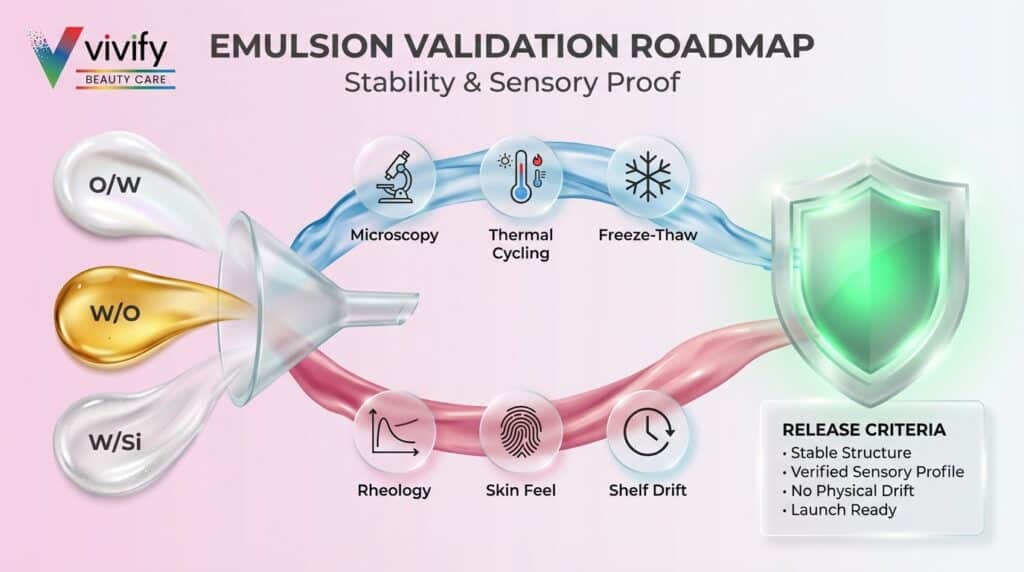
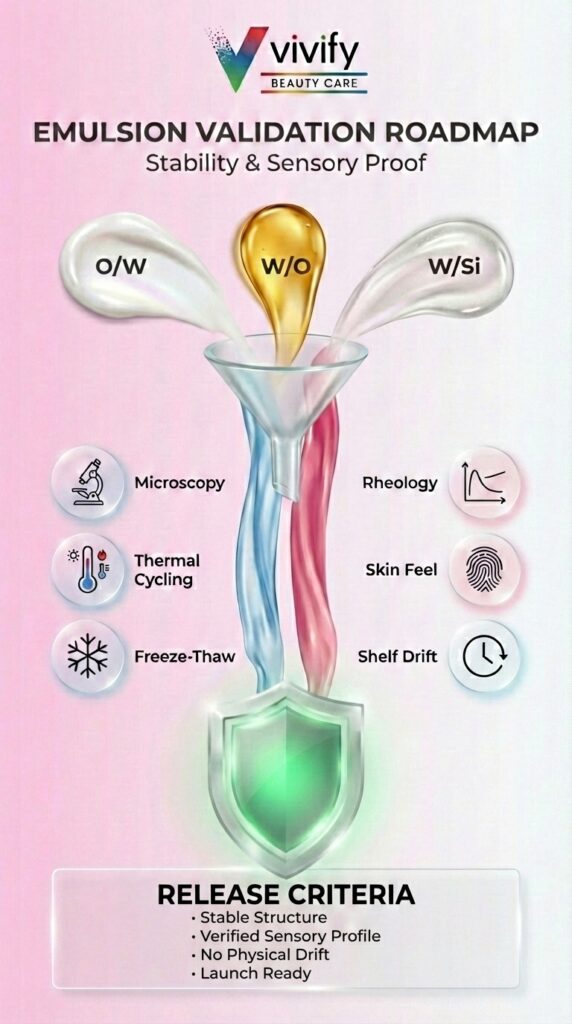
Robust emulsions require thorough validation to confirm both physical stability and a consistent sensory profile over time.12 Because emulsion architecture (O/W, W/O, W/Si—and specialty structures like lamellar networks) influences how products fail, testing should be designed to reflect the most likely failure modes for the chosen structure and the formula’s real-world use conditions (shipping, storage, and consumer handling).1,12
Stability Testing
Practical stability tests include:
- Accelerated Aging: Elevated-temperature storage (commonly ~40°C to 45°C) is often used to stress microstructure and speed detection of separation, viscosity drift, and appearance change—recognizing this is predictive rather than perfectly equivalent to real-time aging.12
- Centrifugation: Analytical centrifugation/centrifuge screening increases apparent gravitational force to reveal separation tendencies and can be used as an early indicator of physical instability risk.1,12
- Environmental Stress Tests: Exposing formulations to temperature/light extremes (as relevant) helps simulate shipping and storage stressors and can uncover packaging/formula vulnerabilities.12
- Freeze-Thaw Cycles: Freeze-thaw testing challenges interfacial films and structuring systems and can expose hidden instability under repeated thermal transitions.12
These tests confirm that the formula’s structure remains stable over time and across realistic stress exposures.12
Sensory Validation
To ensure end-user satisfaction, sensory validation methods include:
- Rheological Analysis: Rheology measurements (e.g., flow curves, yield stress, thixotropy) help connect microstructure to spread, pick-up, and stability behavior across shear conditions relevant to filling and application.1
- Sensory Panels: Structured sensory assessment captures texture, afterfeel, and visual consistency changes that may not be obvious in basic stability screens.12
- Longevity Assessments: Monitoring performance over time helps detect microstructure drift that can influence aesthetics, application, and (where relevant) active-release behavior.1,12,14
By integrating stability and sensory protocols, formulators can iterate based on measurable changes—ensuring both technical robustness and consistent consumer experience.1,12
Common Pitfalls and How to Avoid Them in Emulsion Formulating
A clear understanding of potential pitfalls can lead to more robust formulations. Common mistakes and actionable tips include:
Overlooking Ingredient Compatibility
- Issue: Incompatible ingredients can disrupt interfacial films or microstructure, leading to separation, viscosity collapse, or phase inversion (especially under stress).1,10
- Solution: Conduct early compatibility screens (including stress and temperature exposure) and iterate the emulsifier/structuring package accordingly.12
Misaligned Sensory Expectations
- Issue: A physically stable emulsion can still miss the target if rheology and break profile don’t match the desired application experience.1
- Solution: Combine rheology with structured sensory evaluation and iterate based on measurable attributes tied to sensorial outcomes.1,12
Neglecting Packaging Effects
- Issue: Packaging can affect emulsion stability by altering exposure to oxygen/light and by interacting with formula components; packaging can also influence perceived viscosity and dispensing behavior over time.3,12
- Solution: Include packaging in stability evaluations and align formula protection strategies (e.g., antioxidant/chelation where relevant) with packaging realities.3,4,12
Overcomplicating Formulations
- Issue: Too many stabilizers/modifiers can create competing microstructures and unpredictable failure modes.1
- Solution: Introduce changes incrementally and track the impact on droplet size distribution, rheology, and stress stability outcomes.1,12,13
Misdiagnosing Instability
- Issue: Confusing creaming with coalescence (or other mechanisms) can lead to the wrong corrective action.1,2
- Solution: Use diagnostic tools (e.g., microscopy and droplet size distribution tracking) to identify the dominant instability mechanism before reformulating.1,2,13
Ignoring End-Use Conditions
- Issue: Not accounting for realistic temperature/humidity/handling can undermine performance even if the product looks stable at room temperature.12
- Solution: Stress test under conditions aligned to shipping lanes, storage environments, and user behavior patterns for the target market.12
Advanced Characterization Techniques for Emulsion Systems
To further refine formulations, modern analytical techniques can provide additional insight into droplet structure, microstructure changes, and early instability signals:
- Dynamic Light Scattering (DLS): DLS can support droplet size assessment in appropriate size ranges and help detect shifts that may precede visible instability—especially when comparing batches, processing conditions, or aging timepoints.1,13
- Laser Diffraction: Laser diffraction supports quantitative droplet size distribution measurements over broader ranges, enabling trending across processing changes and stability checkpoints.13
- Advanced Rheometry: Subtle viscosity and viscoelastic changes under varying shear can flag early structural drift tied to long-term stability and sensorial performance.1
These tools help formulators detect and address potential issues earlier—reducing reformulation cycles and improving scale-up confidence.1,12,13
Practical Advice for Real-World Formulation Adjustments
Practical, actionable advice is essential for transitioning from lab-scale formulations to market-ready products:
- Track and Document Processing Variability: Record mixing speeds, temperature holds, order of addition, and shear history to identify trends, reproducibility risks, and root causes when performance shifts.1,12
- Base Adjustments on Measurable Performance Data: Use quantitative signals (e.g., droplet size distribution, rheology, stress stability outcomes) to ensure changes are targeted and verifiable—not just cosmetic improvements.1,12,13
- Maintain Detailed Batch Records: Clear batch documentation improves troubleshooting, enables faster iteration, and supports smoother scale-up and tech transfer.12
This data-driven approach helps minimize risk during scale-up and increases confidence that final products will meet both technical performance and sensorial goals.1,12
Elevating Formulations with the Right Emulsifier Systems
Mastering O/W, W/O, and W/Si emulsifier systems empowers formulators to deliver products that are both technically robust and sensorially appealing. By adopting an architecture-first approach, validating with fit-for-purpose stability and sensory testing, and leveraging advanced characterization techniques, teams can achieve the performance, texture, and active-delivery behavior required for competitive cosmetic products.1,12–14
Specialty microstructures—such as lamellar (liquid-crystalline) O/W emulsions—can further enhance stability and skin feel in targeted applications when properly engineered and validated.11,12,14
If you are an R&D chemist, formulation scientist, or product development leader seeking practical and tailored formulation support, reach out to Vivify Beauty Care. Our dedicated team is ready to help transform your innovative concepts into market-ready products.
References
- Badruddoza, A. Z. M., Yeoh, T. Y., Shah, J. C., & others. (2023). Assessing and predicting physical stability of emulsion-based topical semisolid products: A review. Journal of Pharmaceutical Sciences, 112(7), 1772–1793. https://doi.org/10.1016/j.xphs.2023.03.014
- Ravera, F., Dziza, K., Santini, E., Cristofolini, L., & Liggieri, L. (2021). Emulsification and emulsion stability: The role of the interfacial properties. Advances in Colloid and Interface Science, 288, 102344. https://doi.org/10.1016/j.cis.2020.102344
- Thomsen, B. R., Yesil-Celiktas, O., Kırca, A., & others. (2017). Investigation of lipid oxidation in high- and low-lipid skin care products during storage. Journal of the American Oil Chemists’ Society, 94, 1329–1339. https://doi.org/10.1007/s11746-017-3034-7
- Mancuso, J. R., McClements, D. J., & Decker, E. A. (1999). The effects of surfactants, pH, and chelators on the oxidative stability of oil-in-water emulsions. Journal of Agricultural and Food Chemistry, 47(10), 4112–4116. https://doi.org/10.1021/jf990203a
- Pasquali, R. C., & Bregni, C. (2008). Some considerations about the hydrophilic–lipophilic balance system. International Journal of Pharmaceutics, 356(1–2), 44–51. https://doi.org/10.1016/j.ijpharm.2007.12.034
- Osterwalder, U., Sohn, M., & Herzog, B. (2014). Global state of sunscreens. Photochemistry and Photobiology, 90(1), 62–80. https://doi.org/10.1111/phpp.12112
- Nazir, H., Zhang, W., Liu, Y., Chen, X., Wang, L., Naseer, M. M., & Ma, G. (2014). Silicone oil emulsions: Strategies to improve their stability and applications in cosmetics. International Journal of Cosmetic Science, 36(2), 124–133. https://doi.org/10.1111/ics.12104
- Berardesca, E., & Maibach, H. I. (1992). Effect of occlusive dressings on the stratum corneum water holding capacity and skin barrier function. Contact Dermatitis, 27(4), 205–209. https://pubmed.ncbi.nlm.nih.gov/1642249/
- du Plessis, J., Stefaniak, A., Eloff, F., John, S. M., Agner, T., Chou, T.-C., Nixon, R., Steiner, M., & others. (2013). International guidelines for the in vivo assessment of skin properties in non-clinical settings: Part 2. Transepidermal water loss and skin hydration. Skin Research and Technology, 19(3), 265–278. https://doi.org/10.1111/srt.12037
- Jiang, J., Wang, Z., Wang, C., Shi, L., & others. (2022). Model emulsions stabilized with nonionic surfactants: Structure and rheology across catastrophic phase inversion. ACS Omega, 7(48), 44012–44020. https://doi.org/10.1021/acsomega.2c05388
- Ahmadi, S., McClements, D. J., & others. (2020). Influence of lamellar liquid crystal structure on the stability and performance of topical creams. Pharmaceutics, 12(9), 864. https://doi.org/10.3390/pharmaceutics12090864
- Kirkbride, L., Humphries, L., Kozielska, P., & Curtis, H. (2021). Designing a suitable stability protocol in the face of a changing retail landscape. Cosmetics, 8(3), 64. https://doi.org/10.3390/cosmetics8030064
- Driscoll, D. F., & others. (2001). Physicochemical assessments of parenteral lipid emulsions: Light obscuration versus laser diffraction. International Journal of Pharmaceutics, 219(1–2), 21–37. https://doi.org/10.1016/S0378-5173(01)00626-3
- Otto, A., Du Plessis, J., & Wiechers, J. W. (2009). Formulation effects of topical emulsions on transdermal and dermal delivery. Skin Pharmacology and Physiology, 22(6), 316–325. https://doi.org/10.1159/000235014
- Teeranachaideekul, V., Soontaranon, S., Sukhasem, S., Chantasart, D., & Wongrakpanich, A. (2023). Influence of the emulsifier on nanostructure and clinical application of liquid crystalline emulsions. (PMC). https://pmc.ncbi.nlm.nih.gov/articles/PMC10015016/